Championing Archaeological Businesses

Category: Media releases

  • HS2 – The Biggest Dig

    For three years, FAME members have been working with documentary makers on the HS2 project. This work has results in a three part min-series: HS2 – The Biggest Dig.  Presented by Anthropologist and anatomist Professor Alice Roberts and historian Dr Yasmin Khan, it is now airing on BBC Two, exploring the discoveries found in Britain’s largest ever archaeological programme.

    The BBC series will focus on two major cemetery excavations – one adjacent to London’s Euston station and the other in Park Street, next to Birmingham Curzon Street station – the sites of two new HS2 terminals. Though over 60 sites have been worked on by over a 1,000 archaeologists during HS2.

    The three part documentary series, HS2 – The Biggest Dig, airs on BBC Two weekly from Tuesday 15 September and will be available on BBC IPlayer. You can find the first episode here: https://www.bbc.co.uk/iplayer/episode/m000mmrc/britains-biggest-dig-series-1-episode-1

  • Impact of Covid-19 on Local Authority Archaeology Services

    Impact of Covid-19 on Local Authority Archaeology Services

    A rapid survey of ALGAO:UK members on how the Covid-19 pandemic has affected their work has been published. We are grateful to our colleagues in local authorities who have managed to maintain their planning advice, and supply of historic environment record data, during the Covid crisis. This has facilitated the work of our members, and helped our clients deliver sustainable development in spite of the challenging environment that the lockdown and ensuing return to work has created. The report commissioned by ALGAO presents a snapshot of archaeological planning advice and support for the UK as a whole, as well as by country and region. Report and more information can be found at the ALGAO website: https://www.algao.org.uk/news/impact-covid-19-local-authority-archaeology-services

    Despite the challenging working environment presented by the Covid Crisis, the overwhelming majority of ALGAO members have been able to continue to deliver services as they were able to do before the onset of the pandemic. This means that the availability of local government advice has not been a factor leading to a reduction in archaeological work.

    The majority (c.70%) of ALGAO members have continued to provide a full-service providing planning advice, policy advice, to comment on active developments and to provide Historic Environment Record services, with a further 28% recording a partial service but one focused upon planning and development management and advice.

  • Archaeology is Open for Business

    During the coronavirus pandemic, commercial archaeology companies continue to provide the quality expertise and advice that their clients need while protecting the health and safety of their employees, clients and the public.

    FAME members are already adapting to rapidly changing circumstances and will continue to do so as the situation evolves.

    This includes archaeologists working from home to carry out necessary desk-based assessment and crucial post-excavation analysis, and finding innovative ways to keep working on site and in the field, such as minimising the risks of cross-contamination by keeping fieldworkers in discrete teams.

    FAME members will keep adjusting to the situation, in partnership with our clients, to deliver excellent archaeological results that allow sustainable development to continue.

    FAME, the Federation of Archaeological Managers and Employers, is the distinctive voice of archaeological employers and managers, and the only organisation solely devoted to representing their interests within the profession and the business world. info@famearchaeology.co.uk

    contact for press enquiries: Kenneth Aitchison, CEO, Federation of Archaeological Managers and Employers ceo@famearchaeology.co.uk

  • New Report – Archaeology in Development Management

    ALAGO has just released a new report, Archaeology in Development Management. You can download the report here – https://www.algao.org.uk/archaeology-development-management

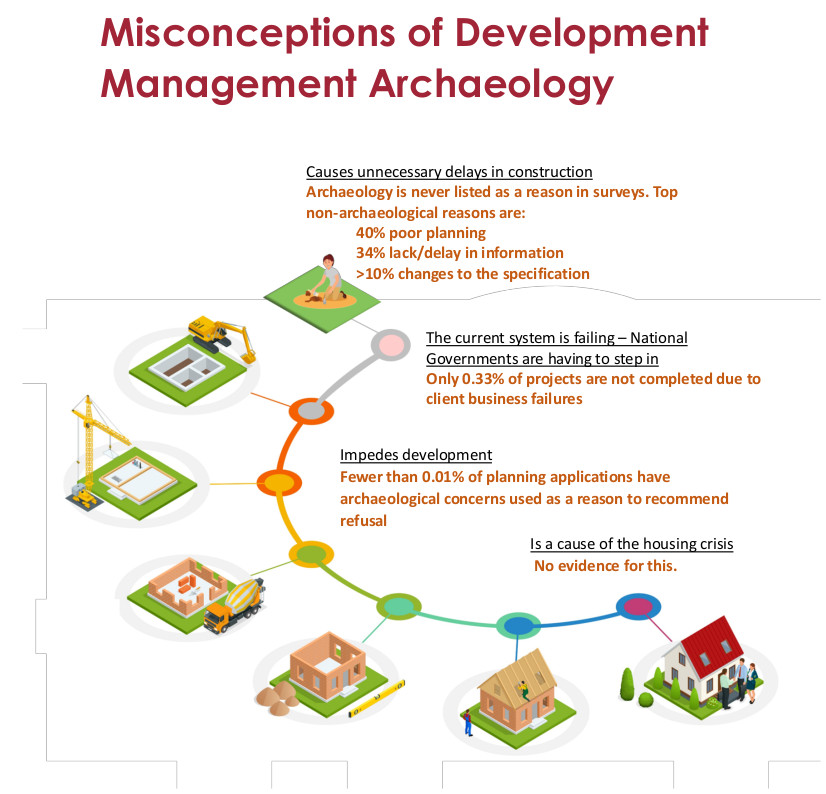
    “New research into the benefits of archaeology work undertaken under the control of Local Authorities across Britain has been published by the Association of Local Government Archaeological Officers (ALGAO) today (6th September 2019)

    Archaeological work was fully incorporated into the planning system across the UK in the early 1990s to manage the impacts that development may have upon the historic environment. The report presents the results of research conducted by Landward Research Ltd for ALGAO:UK, on the archaeology sector in developmental management and its contributions in England, Scotland and Wales.

    The report looks at; the positive impact the existing system makes on the sector and beyond, how successful the existing system is and whether it is delivering the process it was created for.

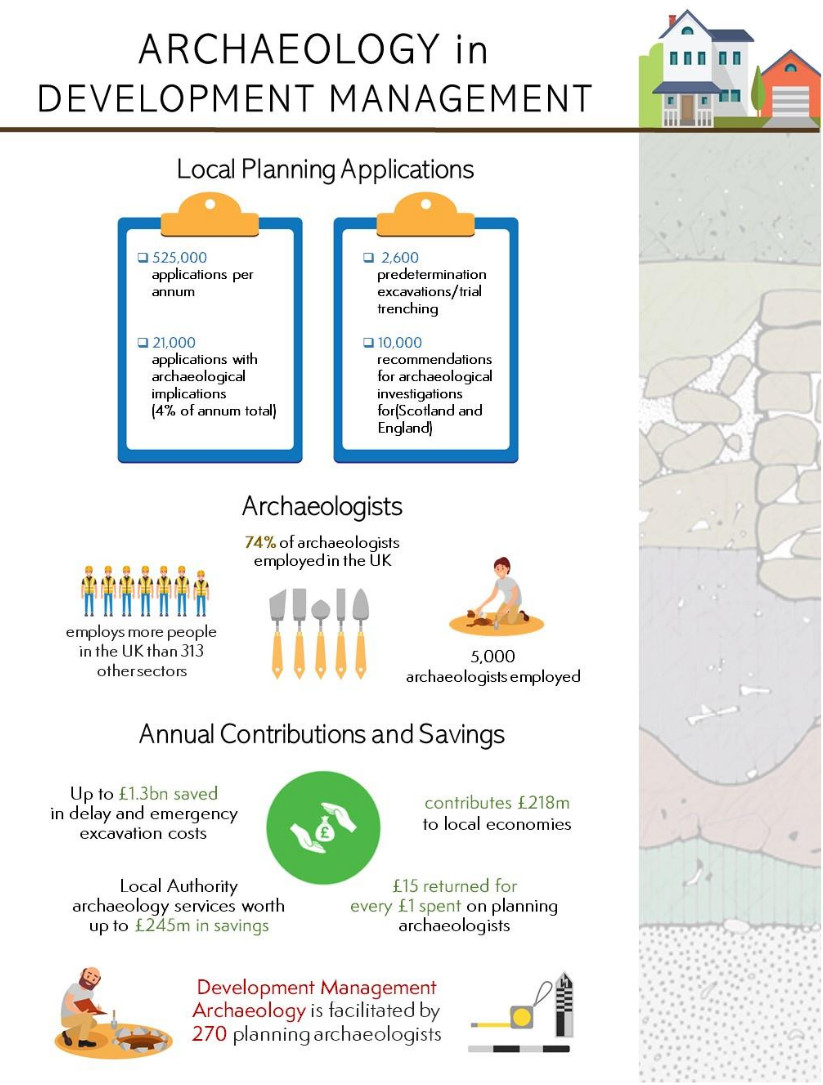
    It’s the first detailed piece of research into the topic by ALGAO and it highlights the savings produced by the current system as well it’s the contribution to the economy:

    • Commercial Archaeology makes a £218m direct contribution to the economy
    • For every £1 spent on Local Authority Planning Archaeology £15 is returned.
    • 5000 (74%) archaeologists are employed because of the developmental management system
    • Work of members provides up to an estimated £1.3bn in savings to construction industry through reduced delay costs in 2017-18 alone
    • Current provision of Local Authority based archaeological services worth up to £245m in savings to public purse in 2017-18

    John Lawson, Chair of ALGAO said:

    ‘’Today’s report by Landward Research has highlighted the essential role currently played by our members in providing expert in-house advise to our Authorities. We enable the conservation of our historic environment at a local level whilst supporting successful development, employment and tourism. Local Authorities are at the heart of promoting the wider public benefits of our rich historic environment, for the benefit of all

    “This report demonstrates the value of incorporating archaeological services into the planning system, and the positive impact this approach can have in terms of the economy and understanding of our historic environment.”

    Kenneth Aitchison, Chief Executive Officer of FAME, the Federation of Archaeological Managers and Employers, said: “This report is really important. It shows the value of ALGAO expertise and emphasises the critical need for this in the planning system. It is ALGAO members’ expertise in local authority planning archaeology that enables FAME members to deliver high-quality archaeological investigations that provide real benefits to society. Without ALGAO, FAME wouldn’t be able to do the work we do”.

    Doug Rocks-Macqueen, from Landward Research said: “We have always guessed that development control archaeology contributes greatly to communities but quantifying the results has been surprising. The impact it has on England, Scotland and Wales is far greater than what we had imagined”.

  • FAME Quarterly Market Confidence Index Report Q4 2018

    The Federation of Archaeological Managers and Employers (FAME) is the voice of archaeological employers and managers in the United Kingdom, and the only organisation solely devoted to representing their interests within the profession and the business world. FAME started life in 1975 as the Standing Conference of Archaeological Unit Managers, before changing the name to FAME in 2008, to reflect more closely our purpose and membership.

    The vision of FAME is to strive for a business environment where archaeological organisations can operate safely and sustainably, the well-being of employees is prioritised and archaeologists feel empowered to build careers and expertise, so that collectively we can conserve and advance knowledge of the past for the benefit of society.

    As part of this vision we support research into the sector. For example, with funding from Historic England and in partnership with the Charted Institute for Archaeologists we have commissioned Landward Research Ltd to conduct annual surveys of our members to gain a wealth of information about the archaeological sector. Part of this research examines the confidence of employers in the business environment. This material helps to estimate future job and resource demand. To get more refined information FAME has decided to launch a quarterly survey of its members’ confidence in the current market.

    You can read the results of the first quarterly survey here: FAME Quarterly Market Confidence Index 4thQ 2018

  • Record Levels of Commercial Investment and Employment for Archaeologists in the UK: Press Release

    Headlines

    Record Levels of Commercial Investment and Employment for Archaeologists in the UK.

    Summary

    The latest Archaeological Market Survey report is now available.

    Key Findings

    • £239m investment in the economy through applied archaeology
    • In financial year 2017-18 the sector grew in terms of the number of employees , financial turnover,and profit levels.
    • 6,812 people were employed as professional archaeologists in 2017-18 more than have ever been before, with 13% from the EU
    • The majority of businesses in the sector expected to expand significantly in the next year (2018-19) (e.g. in premises, vehicles, capital equipment)
    • The overwhelming majority of income came from private sector clients (83%, a slight increase from 81% in 2016-17) with residential housing as the biggest sector, but infrastructure projects were also important.
    • Much of this investment is dependent on the planning process having access to expert archaeological advice
    • East Anglia and the East Midlands were identified as the most prolific regions for archaeological investment as part of development
    • Despite this, the sector’s confidence in the future of the market was declining, and had been since 2015
    • Brexit and the under-resourcing of local government planning advice were still considered to be major concerns for the sector

    You can download the full report at www.archaeologists.net/profession/profiling

    Providing a unique analysis of the archaeological sector as part of the overall UK economy, the report is based on survey responses from FAME members and CIfA Registered Organisations.

    The report was produced by Landward Research on behalf of Historic England, the Federation of Archaeological Managers and Employers (FAME) and the Chartered Institute for Archaeologists (CIfA).

    Press release

    Date

    13 March 2019

    Issued by

    Rob Lennox, Policy Advisor, CIfA

    rob.lennox@archaeologists.net

    Note on the organisations

    The Chartered Institute for Archaeologists (CIfA) is the leading professional body representing archaeologists working in the UK and overseas. CIfA promotes high professional standards and strong ethics in archaeological practice, to maximise the benefits that archaeologists bring to society, and provides a self-regulatory quality assurance framework for the sector and those it serves.

    CIfA has over 3,700 members and over 80 registered practices across the United Kingdom. Its members work in all branches of the discipline: heritage management, planning advice, excavation, finds and environmental study, buildings recording, underwater and aerial archaeology, museums, conservation, survey, research and development, teaching and liaison with the community, industry and the commercial and financial sectors.

    The Federation of Archaeological Managers and Employers (FAME) is the distinctive voice of archaeological employers and managers, and the only organisation solely devoted to representing their interests within the profession and the business world.FAME represents one in three archaeological practitioners, employing the majority of archaeologists across the UK. Its membership includes over 50 archaeological practices, from small consultancies to all the largest contractors, from educational charities, commercial companies, universities and local authorities across England, Scotland,Wales and Ireland. In addition to representing its members’ interests in matters of policy, its aims are to foster an understanding of archaeology across the construction and development sector and promote best professional practice, training and development, and a safe and healthy work environment. https://famearchaeology.co.uk/

    Enquiries about this press release please contact:

    1. +44 (0) 118 966 2841

    kate.geary@archaeologists.net

  • Archaeological Market Survey Report 2015/2016

    The latest Archaeological Market Survey report, produced by Landward Research on behalf of Historic England, FAME and CIfA is now available. Providing a unique analysis of the archaeological sector as part of the overall UK economy, the report is based on survey responses from FAME members and CIfA Registered Organisations.

    Key Findings

    • The market for archaeological services continued to expand in 2015-16
    • The numbers employed in the commercial sector rose and have returned to levels previously experienced in 2009
    • Turnover and profitability have increased across the sector and salaries have generally increased by more than the rate of inflation
    • The vast majority of income comes from private sector clients, with residential development being the most important market sector
    • Business confidence is high (but has been affected by the uncertainty following the EU referendum)
    • Employers are continuing to invest in skills training for their staff but fieldwork skills are still the most commonly reported as being lost
    • Numbers of archaeological staff providing expert advice to local planning authorities are still falling and this remains a serious concern for the sector

    Members can download the report from here.

  • 2015 Archaeology Market Survey

    Hot on the heels of the 2014 market survey comes that for 2015. This important piece of work undertaken by Landward Research, jointly for FAME and CIfA, describes the commercial archaeology sector as of the end of March this year. You will want to look at the detail to compare your organisation’s position with others in the industry, but the headlines are:

    -Employment in the ‘applied archaeology sector’ up by over 20%
    -Turnover up 15%, with margins up slightly to 2.5%
    -Business confidence at an all time high
    -Commercial residential development still dominates
    -Skills gaps still a concern, but the response has been increased training
    -Heightened concern over threats to local government archaeology

    The survey comes at a time when many organisation are expanding and with the prospect of enhanced government spending on infrastructure. The survey makes a vital contribution to understanding the state of the sector and will help to focus efforts on improvement at an organisational and industry level. Members can download a copy of the report by following this link.

  • Heritage Market Survey 2014

    FAME are pleased to present the results of the Heritage Market Survey, 2014, commissioned with CIfA and Historic England, and undertaken by Landward Research. The survey focused on data collected  from commercial organisations (including FAME members) for the end of the financial year 2013/2014 and provides an overview of the structure of the sector, employment numbers and conditions, commercial performance, and levels of confidence going forward. A new updated survey, covering 2014/2015 will be published soon.

    The picture for the survey period was mixed. The worst of the recession was over, levels of work and employment were improving and confidence within the sector was at its highest level since the survey began in 2008. However, turnover was only slightly improved, and while there were opportunities to grow margins, healthy profitability for most employers was still hard to come by. There was, perhaps, an over-reliance on the housing and energy sectors, but this reflects the wider construction market. The majority of respondents predicted continued improvement and growth into 2015, and again, unsurprisingly, this reflected broader levels of confidence in the UK economy at the time. But the survey identified a number of challenges, notably the difficulty in recruiting sufficient fieldwork staff. Many are responding to this by raising wages and putting in place more structured training.

    The value of the survey lies not so much in the historic data, but in how it can help our member organisations plan for a successful future and it will be very interesting to compare results with the 2015 survey when these are available. Over the coming weeks we will be drawing out some of the themes in the surveys to open up discussions around how FAME can support its members in this growing market.

    The full report can be downloaded from HERE and is available in the members library.

    Nick Shepherd

  • Pay and archaeology: a joint statement by IfA, FAME and Prospect

    The Institute for Archaeologists (IfA), Federation of Archaeological Managers and Employers (FAME) and Prospect have been working together as part of a wider remuneration working group convened by IfA to consider how best to facilitate an industry approach to improving pay and conditions.

    Following on from presentations made by all three organisations at an Open Forum meeting at the IfA Conference in 2013, a joint statement has been agreed committing each organisation to working together to address the issues. In support of this joint statement, IfA has also issued an Action plan 2014-2016 detailing specific actions which it will undertake over the next two years in support of the joint statement.

    In a move towards an industry wide approach, the IfA convened working party is being disbanded and a new ‘industry owned’ group will be formed. This will initially comprise representatives of the three organisations but may be expanded to bring in other members with an interest or expertise in improving pay and conditions for archaeologists.

    The statement can be read here: