Championing Archaeological Businesses

Category: Health & Safety

  • The Official HSE Health and Safety app for SMEs

    The Official HSE Health and Safety app for SMEs

    FAME would like to alert all FAME members and archaeology organisations that the Health and Safety Executive has released an a bespoke mobile app designed for small businesses or anyone new to health and safety. This app will help you to understand the law, your health and safety rights, your responsibilities and how to protect employees. The app contains core guidance on what the law requires and the responsibilities an employer has under the Health and Safety at Work Act 1974.

    This app is not designed for health and safety professionals, consultants or those looking for detailed information on health and safety law.

    There is a very small fee of 2.99 and can be bought on the Apple iOS store and the Google Play Store.

  • Development-led archaeology Health and Safety statistics 2019-20

    Development-led archaeology Health and Safety statistics 2019-20

    The results of the FAME 2019-20 Health and Safety Injury Survey are now available. The document can be downloaded here: FAME Health and Safety Injury Survey 2019-20


    3 Key Findings:

    1. Significant drops in RIDDOR Injury frequency rates & Incident rates:
    • Specified injuries:
      • 0.21 & 42 in 2019-20
      • 2.01 & 342 in 2018-19
    • Injuries resulting in over 7 days absence:
      • 0.43 & 84 in 2019-20
      • 1.51 & 256 in 2018-19
    1. Archaeology had comparable RIDDOR injury rates to the arts and entertainment industries in 2019-20, lower than construction and construction-related industries. Caution: it will take averaging multiple years to get accurate numbers for the sector, this is only year two of a four- to five-year process.


    1. Ergonomic/Manual Handling made up a third of non-RIDDOR reported injuries as it did for 2018-19 and is of concern for the sector.


  • H&S Notice: Traffic management

    H&S Notice: Traffic management

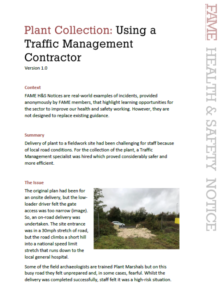
    To help support the goal of safe working conditions for all archaeologists, FAME will be publishing Health  & Safety notices for its members, and the sector at large, to learn from. These will be a mixture of instances of upcoming changes to Health & Safety regulations and incident reports, anonymously provided by FAME members. We hope these incident reports highlight potential areas to improve our working practice.

    The first notice is a learning incident plant collection and traffic management. Please download it from this link: FAME H&S notice – Traffic Management

  • HSE’s Noise exposure calculator changes

    HSE’s Noise exposure calculator changes

    The Health and Safety Executive has made changes to its noise exposure calculator. This tool can help you work out your daily noise exposure, weekly noise exposures, and estimate the performance of hearing protection.

    The updated calculator can be found on their website at: https://www.hse.gov.uk/noise/calculator.htm?utm_source=govdelivery&utm_medium=email&utm_campaign=health-noise&utm_term=exposure-calc-1&utm_content=noise-5-apr-21

  • Six evidence-based interventions, adapted from public health models, that archaeology organisations can adopt to measurably reduce harassment

    Two new Open Access articles have been published on the topics of harassment in Archaeology: 

    Documenting Cultures of Harassment in Archaeology: doi.org/10.1017/aaq.20

    Disrupting Cultures of Harassment in Archaeology: doi.org/10.1017/aaq.20

    In addition, the author, Barbara Voss, has also posted a blog article with six evidence-based interventions, adapted from public health models, that archaeology organisations can adopt to measurably reduce harassment

    https://www.cambridge.org/core/blog/2021/03/23/using-public-health-interventions-to-prevent-harassment-in-archaeology/

    1. Listen to survivors and vulnerable members of the discipline. They will know where the problems are and what can be done to stop them. Conduct regular climate surveys and listening sessions to monitor changes in team dynamics. Emphasize that reporting harassment is a courageous act that supports the health of the organization.
    2. Define harassment as scientific and professional misconduct. Every professional society, university, museum, research institute, and publisher should clearly state that harassment will be taken as seriously as plagiarism, falsification of data, and trafficking in antiquities. In the United States, Congress needs to pass the “Federal Funding Accountability for Sexual Harassers Act,” which would require institutions to formally report verified harassment on federally funded research projects.
    3. Establish an independent, global harassment reporting hotline with powers to investigate reports of harassment and resources to support survivors. In Great Britain, the Chartered Institute of Field Archaeologists has partnered with a non-profit organization to provide channels for reporting outside of organizational chains of command.
    4. Require codes of conduct with clear mechanisms of enforcement for all archaeology research and educational programs. This has been shown to dramatically reduce harassment on field projects. Every permitting agency, research funder, lab facility, and museum can incentivize this practice by making codes of conduct a required element of any application or request.
    5. Change organizational procedures to reduce potential abuses of power by gatekeepers. Install checks and balances in academic advising and workplace supervision to mitigate early-career archaeologists’ vulnerability. For funding, permits, hiring, and other high-stakes career decisions, establish open and transparent procedures with decision-making power vested in committees or boards rather than individuals.
    6. Include training in interpersonal skills as part of education and mentorship for archaeology and other team-based sciences. Along with awareness of team dynamics and conflict management for research leadership, upstander training empowers all team members to intervene in harassment and to use their character strengths to build safe and inclusive team dynamics.

    UPDATE

    Prospect has reach out to us to share a report on harassment they conducted and their similar recommendations:

    Archaeologists Branch Research Paper 1

    • Strong leadership is crucial
    Workplace leaders, whether management or activists, must definitively commit to the challenge of tackling sexual harassment. It is essential that they know how that translates into practice. A strong statement of intent, followed by weak or inappropriate action, actively undermines trust in the workplace to deal with misconduct. Workplace leaders, from the chief executive down, must understand their role in supporting culture change, and have a plan in place to deal with disclosures of misconduct.
    • Create diverse, respectful workplace cultures
    Sexual harassment is not the responsibility of ‘a few bad apples’ – it is a cultural problem. The strongest protection against sexual harassment is a shift towards a respectful workplace culture, predicated on values of diversity and inclusion. Lasting culture change is often driven by the grassroots, whilst being supported from the top. Importantly, every worker must feel safe and supported to challenge behaviour that makes them, or their colleagues, uncomfortable.
    • Tackle the most common forms of sexual harassment
    The vast majority of sexual harassment in workplaces is ‘low-level’, verbal hostility: sexist jokes, unwanted comments on appearance. This background harassment is degrading and humiliating in its own right. It also paints a picture of permissiveness towards sexism, supporting progression to more aggressive, more severe types. A workplace that is serious about stopping sexual harassment must understand the full spectrum, and make clear that no form of sexism or discrimination will be tolerated.
    • Diffuse the power relationships
    Power relationships exist in all workplaces: hierarchies and decision-making structures; social networks; demographic imbalances. Some serve a useful purpose, but any may be subject to abuse. Workplaces should ‘map’ their organisational power dynamics, formal and informal, and manage the risks they present.
    • Support the targets of sexual harassment
    Most sexual harassment is unreported, because the victims don’t trust their workplaces to deal with it appropriately, or in a way that protects them. We recommend a system for dealing with disclosures of sexual harassment that gives autonomy back to the victim: laying out a range of possible actions, and alternative sources of support, for them to choose how to proceed, if they choose to proceed at all. Where the targets of sexual harassment feel safe to disclose it, the workplace has the best chance of tackling the problem.

  • Making your workplace COVID-secure during the coronavirus pandemic

    Making your workplace COVID-secure during the coronavirus pandemic

    The Health and Safety Executive has created an overview of the things you should do to help make your work and workplace COVID-secure. Essentially, a list of all the relevant guidance. This is for employers, but workers and the self-employed and FAME recommends all members look at it to ensure you are undertaking best practices:

    https://www.hse.gov.uk/coronavirus/working-safely/index.htm?utm_source=govdelivery&utm_medium=email&utm_campaign=coronavirus&utm_term=covid-updates-secure&utm_content=digest-25-feb-21


  • Construction (Design and Management) Regulations 2015 – Advice for Archaeological Practitioners

    Construction (Design and Management) Regulations 2015 – Advice for Archaeological Practitioners

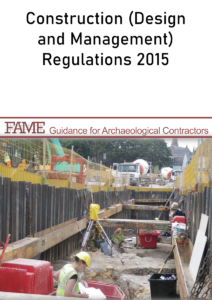
    The FAME Health and Safety group has been working on creating advice for FAME members on a range of issues. We are happy to announce the publication of our advice on Construction (Design and Management) Regulations 2015.

    Key Take Away

    “Both FAME and the HSE discourage archaeologists from undertaking a role automatically, or by default, for which they may not be qualified, and which may result in significant health and safety and commercial risk.”

    The principal author of this paper was Luke Brannlund (Cotswold Archaeology) with input from other members of the FAME Health and Safety Working Group. FAME is very grateful to Russell Adfield and his colleagues at the HSE for the advice they gave during the production of this paper.

    Our guides rarely change but occasional updates do occur and it is best to check this page for the most recent version.

    The guide has been updated to version 3. June 2024.

  • COVID security to retain construction’s ‘essential’ status

    Dear FAME members,

    As you will be aware the various government authorities that we operate in have issued guidance on construction work during the most recently imposed restrictions:

    England – the recent (11January 2021) letter from the Rt Hon Kwasi Kwarteng MP Secretary of State at BEIS confirming the construction sector’s continuing ‘essential’ role:

    “firms and tradespeople in the construction sector and its supply chain [my emphasis], including merchants, suppliers and product manufacturers, should continue to operate during this national lockdown”

    Northern Ireland’s guidance is in effect until 6 February, but will be reviewed on 21 January (we do not anticipate it changing). https://www.nidirect.gov.uk/articles/coronavirus-covid-19-regulations-guidance-what-restrictions-mean-you

    In Wales, new guidance was issued on 23 December  – https://gov.wales/construction-and-outdoor-work-coronavirus-workplace-guidance-html

    For Scotland, the guidance has not changed since the summer –https://www.gov.scot/publications/coronavirus-covid-19-construction-sector-guidance/

    In the UK, across all nations, construction and its supply chain, i.e. us, are to continue working. Though from the 8th of January it has been shut down in the Republic of Ireland except for essential work: https://www.gov.ie/en/publication/2dc71-level-5/#construction

    Which means the following is only for those of you operating in the UK. We have been told that this continued work is predicated on the industry continuing to operate in a COVID secure way.

    As such, FAME advises that new CLC Site Operating Procedures version seven https://www.constructionleadershipcouncil.co.uk/wp-content/uploads/2021/01/Site-Operating-Procedures-Version-7.pdf

    sets the appropriate minimum for on-site work, supported by working advice produced by Prospect (COVID-19 Working Advice V1.1 04/05/2020) as guidance to undertake risk assessments and to implement appropriate measures to ensure safe working practices.

    Though members in Scotland should also use this guidance, in effect from January 11th,  https://www.cs-ic.org/constructionscotland/resources/working-on-site-during-the-covid-19-pandemic-construction-guidance/

    Furthermore, we would like to highlight the Social Distancing for Archaeology (SoDA) Toolkit (https://soda-toolkit.info/ ) as a resource for you. A recording of the FAME webinar Working with COVID restrictions in Archaeology. A review of the Social Distancing for Archaeology (SoDA) Toolkit is accessible to all at https://youtu.be/TnvrIofWeZs.


    Kenneth Aitchison

    CEO FAME

  • FAME Supports Seeing Red

    FAME Supports Seeing Red

    FAME, the trade association for archaeology in the UK and Ireland, has teamed up with the Seeing Red project to provide all FAME member organisations with period packs – the size small first aid kits and just as important. These kits contain essential supplies to deal with menstruation for archaeologists out in the field or in the office, from packs of tissues to waste bags to various types of tampons and pads. These packs help employers and individuals to deal with issues of menstrual health and hygiene on sites, as well as contributing to tackling period poverty.

    Seeing Red is a menstruation revolution for archaeology, fieldwork and heritage industries. Run by archaeologist Amy Talbot, the initiative is promoting better menstrual health and hygiene on sites, equipping staff with the confidence to talk to site management about periods, and enabling management to deal appropriately with menstruation on sites. Seeing Red recognises that it is not only cis women that menstruate and is open to support all who could be affected by menstruation.

    Our CEO, Kenneth Aitchison, had this to say about the project, ‘It is amazing to see what Seeing Red has achieved since it was launched a year ago. FAME champions health, safety and hygiene in archaeology and the FAME Board of Directors was pleased to unanimously agree to fund the provision of period packs to all our members’.

    Amy Talbot, ‘Until now I have been creating the packs using my own funds and a small anonymous £50 donation, so it was great that FAME stepped forward to help fund the provision of packs to their members who make up so much of the development-led, commercial archaeology sector. I hope even more archaeological organisations will now come forward to provide their staff, students and volunteers with the packs.’

    In addition to the period packs, Seeing Red has also produced, a guide, costings and a set of answers to common questions. All of these can be found on the Seeing Red page of the Mentoring for Womxn in Archaeology and Heritage website https://mentorwomxn.org/2020/06/05/seeing-red/
    If you would like to discuss the Seeing Red initiative or to donate to support their work, please contact Amy at amymentoringwomeninarch@gmail.com.

  • The provision of hygiene bins and disposal of contents on archaeology sites

    The recording of our final FAME webinar of 2020 is now available:

    Recording: https://youtu.be/HMjZBriffoc

    This webinar will examine the legislation and regulations that cover provision of hygiene bins and disposal of contents. The speaker will mention why the Brilliant Bin system fits that legislation but principally it will be to advise what the range of options are.

    Delivered by Susan Hofgartner, of Brilliant Bins, who started work as an accountant and working at board level in various SMEs. Managing finance and administration in these companies, she inevitably got involved in the contracts for the hygiene bins. That convinced her that there must be a better way to deal with this issue. In 2008 she started working on the project and submitted patent applications for the long-life disposable bins, followed by launching them in 2010.

    WM3 Guidance on the classification and assessment of waste (1st Edition v1.1 ) Technical Guidance

    https://www.gov.uk/government/publications/waste-classification-technical-guidance

    See Example 4 at the end of Section A, page A42

    Workplace (Health, Safety and Welfare) Regulations 1992

    https://www.hse.gov.uk/pubns/priced/l24.pdf

    Particularly:

    Regulation 3 – Construction Sites

    Regulation 3 – Temporary Sites

    Regulation 20 and 21