Championing Archaeological Businesses

Category: Innovation and Research

  • Unlocking the Past: The Biomolecular Toolkit

    Created by FAME and funded by BioArCh, at the Department of Archaeology, University of York, this toolkit is an educational video series designed to help development-led archaeologists integrate biomolecular techniques into their project designs:

    Film 1: Introduction & Overview – A guide to what the videos cover, strategic sampling protocols, and balancing scientific data with commercial budgets.

    https://youtu.be/vN6-yZZyd9o

    Film 2: Human Remains – Exploring how aDNA, stable isotopes, and proteomics unlock data on past diet, mobility, biological sex, and kinship.

    https://youtu.be/kW17H2SsfRM

    Film 3: Non-Human & Environmental Remains – Investigating ancient economies, artefacts, and landscapes through lipid residues, ZooMS, seeds, and soil eDNA.

    https://youtu.be/Cg1IIfB8yTg

    For a more expansive discussion of techniques, please see the recording of the workshop at the FAME Forum:

    https://youtu.be/5w2XnAmQ7QU

  • Buried Archaeology & Solar Farms: a talk on the new practice guide

    Rob Sutton, from Cotswold Archaeology, discussed the new Archaeology & Solar Farms at the FAME Forum and provided some insights into the work behind the scenes and its goals.

    https://youtu.be/Znl1Vp_59vU

  • Collaborative Approaches to Bioarchaeology and Biomolecular Archaeology in Commercial Archaeology

    At the FAME Forum, we had a workshop on the range of Bioarchaeology and Biomolecular Archaeology techniques that could be employed on development-led archaeological projects. It is a speed run through many of the possible techniques that one could use. The recording of that presentation by Professor Michelle Alexander and Dr Jessie Hendy of the University of York’s BioARCH team is now publshied:

    https://youtu.be/5w2XnAmQ7QU

  • Ground Truths: commercial archaeology in 2026

    A presentation from our former CEO on some of the findings of the recently published State of the Archaeological Market Survey, given at the FAME Forum:

    https://youtu.be/lSl3zva8oF4

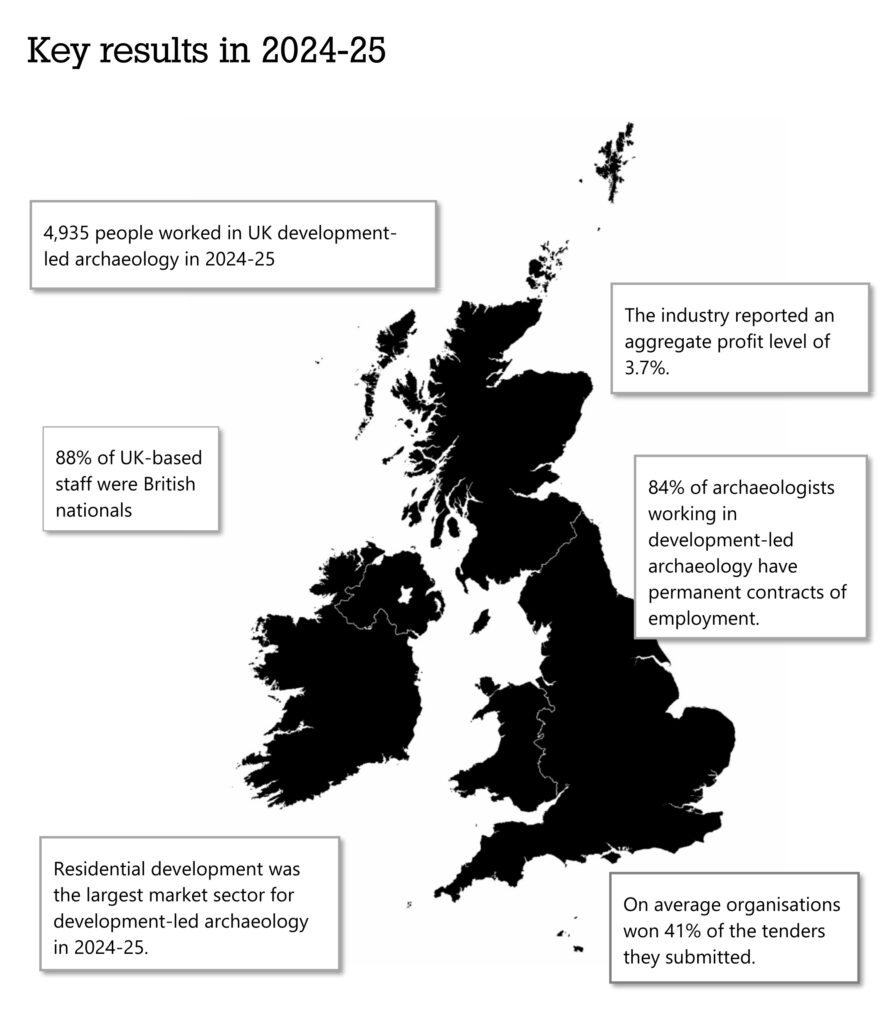
  • 2024-25 State of the Archaeological Market Report

    We, with the support of the Chartered Institute for Archaeologists (CIfA), have conducted another State of the Archaeological Market survey, and the results are now available in a report, published below.

    The report provides a wealth of information on the size and nature of the archaeology market in the UK and its contribution to the wider economy, generating statistics that allow an estimation of the total value of the sector to the economy. This data helps to forecast future demand for archaeological services, and deepens understanding of the sector, which enables us (FAME and CIfA) to target resources and support our members, as well as highlighting the valuable contribution archaeology makes to society. Some key highlights:

    You can download the full report here:

  • Our Past, Our Future Call for Case Studies: Heritage, History and Wellbeing in Scotland Demonstrator Programme

    A request from HES:

    “Historic Environment Scotland and the University of Birmingham are gathering examples of organisations, projects and individuals across Scotland using history and heritage, including intangible heritage, to improve people’s wellbeing.

    The University of Birmingham has been commissioned by Historic Environment Scotland to build a database of case studies to support Our Past, Our Future (Scotland’s strategy for the historic environment) and demonstrate how the heritage sector contributes to Scotland’s wider national priorities, including health and wellbeing.

    Selected examples will be showcased on the Our Past, Our Future website, providing real-world evidence of the value of heritage to wellbeing for partners, policymakers, and funders.

    We would value your input in helping us build a database that reflects the full breadth and diversity of heritage and wellbeing work across Scotland. Whatever shape your work takes – big or small, well-established or just starting out, backed by formal evaluation or anecdotal evidence (such as talking to your participants) that shows it’s making a difference – we want to hear about it!

    Any organisation, project, or individual working in or with Scotland’s historic environment or heritage sector, including:

    • Heritage sites, museums, and archives
    • Community heritage groups and trusts
    • Arts and culture organisations working with heritage themes
    • Health, social care, or wellbeing services partnering with heritage projects
    • Local authorities and place-based initiatives

    We’re especially interested in examples that show one or more of the below:

    • Show a clear link between a heritage activity and a wellbeing outcome (e.g. reduced isolation, improved mental health, stronger community connection, increased sense of purpose or belonging)
    • Include real people’s experiences – quotes, stories, or reflections from participants where possible
    • Can be illustrated with photographs (with permission to use them)
    • Have tried to measure or evidence social value, wellbeing, or wider outcomes using a specific methodology or data collection approach — whether or not it worked as hoped. Understanding what’s already been tried, and what you learned from it, is just as valuable to us as a polished success story!

    Don’t have a fully-formed case study yet? Tell us anyway!

    We also want to hear from you if you believe your activity generates positive outcomes for wellbeing, even if you don’t currently have evidence or a fully developed case study. Many organisations have anecdotal evidence of impact and that’s valuable too.

    We’ll ask you to share

    • A short description of your project or activity (what you did, where, who was involved)
    • The wellbeing outcome or change you observed, and how you measured this (including any methodology or approach you used, even informally)
    • Any supporting evidence, feedback, or quotes from those involved
    • Photographs or other visual material, if available (please only submit images you have permission to share)
    • Your organisation’s/project’s name and a contact person

    How to submit

    Online form: https://app.onlinesurveys.jisc.ac.uk/s/bham/hes-heritage-and-wellbeing-in-scotland-examples

    Deadline for submissions: 9th October

    If you have any questions, please get in touch with Dr Amy Luck, University of Birmingham at a.luck.1@bham.ac.uk.

    We look forward to hearing about your work!”

  • Radiocarbon Training: New Radiocarbon Database for Britain & Ireland

    There is an opportunity for free training on the new, live radiocarbon database for Britain and Ireland; the first repository of its kind.

    This hybrid training day works through the lifecycle of radiocarbon data, from sample selection right to deposition. It will provide a practical introduction to the new radiocarbon database as a research tool, with a focus on Scottish data, including an introduction to analysing results. There will be dedicated time for Q&A throughout.

    DETAILS
    When: 22nd October 2026, 10am–3pm

    Where: In person at the Engine Shed (Forthside Way, Stirling, FK8 1QZ), or join online
    (hybrid session)

    Cost: Free

    Booking: https://www.eventbrite.co.uk/e/radiocarbon-training-new-radiocarbon-database-for-britain-and-ireland-tickets-2002022196282?aff=oddtdtcreator

    Category: Research, Developer-led archaeology

    Event type: Learning session

    Level: Quite technical

    Audience: Developer-led and academic archaeologists, local and national government curators, museum staff, archivists, data managers, postgraduate researchers, and members of local societies

    Time: 10am to 3pm

    OVERVIEW

    Radiocarbon dating is central to how we understand the past. Every year, thousands of results are produced. Yet until now, these data have often been scattered, hard to find, or at risk of being lost altogether, with no single agency officially responsible for safeguarding. Project Radiocarbon changes that — led by academics at Manchester Metropolitan University and University College Dublin and working with partners including Historic Environment Scotland, Historic England, and heritage bodies across Ireland — it brings together 35,000+ dates from across Ireland and Britain into one open, searchable, map-based repository.

    If you work in or research archaeology or heritage this is your chance to see how the
    new system makes data more visible, more useful, and permanently safeguarded.

    Learning outcomes
    By the end of this session, participants will be able to:

    • Understand the principles of radiocarbon dating, and how to select appropriate
      samples for reliable results,
    • Understand how Bayesian statistical analysis can combine ¹⁴C dates with site-
      stratigraphic, phasing and other chronological information to produce more
      precise chronologies,
    • Search and navigate the Project Radiocarbon repository using its interactive
      map-based interface, search by period, site type, or geographic scale, and
      understand how tools like Period reconcile different regional terminologies,
    • Contribute to the development of the practical process and standards for
      submitting new radiocarbon results to Historic Environment Scotland via the
      repository,
    • Apply the repository’s resources to their own research, heritage management, or
      public engagement work.


    Who should attend?

    Archaeologists and heritage professionals working with radiocarbon
    dates in planning/infrastructure projects.

    Curatorial and planning archaeologists in local authorities and heritage
    agencies

    Academic researchers and postgraduate students

    Museum and government heritage staff

    Anyone in Scotland’s archaeology sector curious about the new
    repository

    Fees

    Spaces are free but limited — sign up via Eventbrite to secure your place.

    Schedule

    10am-10.15am Introduction
    10.15am-11am Session 1. Intro to 14C and best practices in sample selection
    11am-11.30am coffee
    11.30am-12.15pm Session 2. Bayesian analysis
    12.15pm-1pm lunch (find your own. Attendees are welcome to bring things and sit and
    eat in the auditorium)
    1pm-1.45pm Session 3. Using the database – worked examples.
    1.45pm-2.30pm Session 4. Depositing results with HES
    2.30-3pm Q and A

  • Developing resources to support historic environment sector apprenticeships

    If you’re an employer in the historic environment sector and you’re wondering whether you could take on an apprentice, but don’t know where to start, CIfA is providing support.

    CIfA is working with employers across the sector to develop a suite of resources to support companies who want to deliver apprenticeships in the sector but are struggling to take the next steps.

    These resources include a template business case to make the case for supporting an apprenticeship to decision-makers, a step-by-step guide to setting up an apprenticeship, and guidance on designing an appropriate training programme. They are also developing case studies from employers who have successfully hosted apprentices, and are running a series of online support sessions to link employers with training providers – with dates and details listed below.

    The project is funded by Historic England, and resources are focussed on English employers initially, but will be moving north of the border shortly, thanks to funding from Historic Environment Scotland, where a Modern Apprenticeship is also under development.

    The online support sessions will give you the chance to meet representatives of the colleges delivering the training, ask questions and hear about the advice and support that’s available to you. Best of all, they are completely free.

    All drop-in sessions are on-line, via Teams. To book, please follow the links below:

    6 October 3-4pm

    15 October 1-2pm

    21 October 12-1pm

    27 October 11am – 12pm

  • Commercial Archaeological Geophysics Seminar

    After a 12-year break, CAGS returns to Bradford on 9–10 July 2026 — hosted by FAME member Magnitude Surveys.

    Please find below a flyer with a full overview of both days. In short, Thursday takes stock of where commercial geophysics stands today, and Friday looks ahead to where it is going. Between the two, it will bring together a broad range of voices — surveyors, consultants, commissioners, regulators, planners, researchers and international contributors — for two days of honest, challenging and useful conversation.

    Book tickets here: https://cagseminar.org/abstracts-tickets

  • Curating the Palaeolithic project: Feedback survey

    Consultation on the Curating the Palaeolithic project, which produced guidance and case study documents that sought to explain the importance of the English Palaeolithic record in its Pleistocene context, and outline best practices for protecting it through the planning process, illustrated by case studies from across the country. The project documents can be found here: https://historicengland.org.uk/images-books/publications/curating-the-palaeolithic/

    The documents were published online on 9th January 2023, and they are now seeking feedback on their impact and usage to date, even if you were not previously aware of them. Survey here Curating the Palaeolithic project: Feedback survey – Fill in form.

    All feedback will be treated anonymously. They anticipate that the survey should take no more than 15-20 minutes to complete. The survey is aimed at those employed in development-led archaeology, who have previously and/or currently worked with Palaeolithic and/or Pleistocene remains.

    They plan to use your feedback in two ways: (i) to help us revise how we circulate and signpost the documents; and (ii) to inform revisions of the documents. The survey will be open until 31st May 2026 and all feedback will be anonymised. Please try not to include any ‘identifying information’ in your responses (e.g. individual, company or archaeological site names). Any inadvertently included ‘identifying information’ will be removed at the data analysis stage and excluded from any data visualisations (e.g. infographics) or other reporting of the data, to ensure anonymity. Survey feedback will be securely stored on a University of Reading OneDrive account and deleted by the end of 2026. You can opt out at any point prior to submitting the completed on-line survey.

    If you have queries or concerns about any aspects of this feedback survey, please contact Rob Hosfield (r.hosfield@reading.ac.uk).