Championing Archaeological Businesses

Author: Doug Rocks-Macqueen

  • Modern Slavery Campaign and the Construction Sector

    Home Office have launched a new modern Slavery Campaign. The construction industry is one of the common areas of labour exploitation and modern slavery identified in the campaign. The Home Office has created resources to help people identify victims which can be found here: https://www.gov.uk/government/publications/modern-slavery-closer-than-you-think

  • State of the Archaeological Market 2020

    This year’s State of the Archaeological Market has now been published and can be downloaded here. A summary and forward from the Chair:

    This survey presents the latest understanding we have of the health and economic performance of commercial archaeological practice in the UK and the Republic of Ireland. It demonstrates the value we make to the overall economy, and the improving sustainability of the sector when measured by permanent employment contracts, the level of turnover per staff member, and levels of profit. Compared to other SMEs within the UK economy for 2020, where only 70% have recorded profit, commercial archaeology seems to be doing well. This situation allows confidence in a sustainable future for the sector and enables managers and employers to plan effective development of their organizations.
    Previous surveys have highlighted the sector’s dependence on housing as the principal source of funding, but the huge government investment in infrastructure for road and rail has had a direct effect on the type of archaeological project that now predominates. This change has affected working practices as well as funding streams, as the scale of such projects has necessitated greater collaboration between different practitioners so that consortia and joint ventures, as well as other kinds of partnership, have developed. The upskilling in project management and health and safety is also evident, with expectations from infrastructure and public sector funding placing new demands on archaeologists. Engagement with those responsible for setting standards in these fields is now being conducted by FAME, so that the
    requirements imposed on those delivering strategic schemes can be proportionate to the role that archaeologists perform.
    The survey also provides evidence for extreme variation in development and the need for commercial archaeological practice, with nearly 30% of the total value in London and the south-east, rising to c.50% when the East of England and East Midlands are included. It demonstrates the unequal distribution of archaeologists, which must influence variations in pay and conditions within the sector, as market conditions dictate supply and demand. We remain dependent on a significant contribution from colleagues coming to us from abroad, but the survey also shows how many organizations are providing training opportunities and developing a future home-grown skills base. FAME members should be proud of what they have achieved, and this survey should give them confidence for the future.


    Tim Malim, Chair: Federation of Archaeological Managers and Employers
  • Archaeological Achievement Awards

    Archaeological Achievement Awards

    Nominations for the Archaeological Achievement Awards are open!

    Formerly the British Archaeology Awards, the Archaeological Achievement Awards celebrates accomplishments from across the United Kingdom and Republic of Ireland.

    There will be five award categories and one overall outstanding achievement award with an emphasis on a range of cross cutting themes that are designed to show how archaeology relates to wider society, health and wellbeing, and place.

    These include:

    • Archaeological Innovation
    • Early Career Archaeologist
    • Engagement and Participation
    • Learning, Training and Skills
    • Public Dissemination or Presentation
    • Annual Outstanding Archaeological Achievement Award

    Nominations close on the 31st October, you can click here to nominate a person or project: https://www.archaeologicalawards.com/about-awards/nomination-form/

  • Request from Historic England deadline 29th October

    Request from Historic England deadline 29th October

    As part of their Inclusion Strategy 2021-2023, Historic England is committed to making the heritage workforce and volunteers more representative of society. However, they need to have data on the current demographic make-up of the sector’s workforce (including volunteers and governance roles), to inform the next steps. The results of this work will be made available to the sector to help inform future work on improving the diversity of the workforce, and to understand gaps in data within the sector.

    The questions they are seeking to answer through this research are:

    • What does the workforce of the Heritage sector currently look like? 
    • How does this compare with the demographic make-up of England?
    • What does the workforce in the Heritage sector look like with regard to different job roles?

    The first phase of this will be about understanding which data is already held within the sector, and which organisations are already collecting data:

    1. Please open the document attached and follow the instructions:
      1. EVERYONE please complete the table and email it to the address shown.
      2. If you have reports and are able to upload them please follow the instructions to do this.
      3. If you have information but prefer to send it by email or by post there is an address provided.
    2. Please respond by October 29th.
  • Beyond the isolated farmstead – relationships between households and settlements in the Iron Age: A research seminar by FAME member Oxford Archaeology

    ‘Almost every family living solely by its own means sooner or later discovers it has not the means to live’ (M Sahlins, Stone Age Economics)

    Despite this observation, the notion that many Iron Age settlements were self-sufficient farmsteads remains pervasive in Britain. Chris Hayden, Matt Brudenell and Andy Greef will look at recent OA excavations in East Anglia, Essex and the Upper Thames Valley, and they will be joined by a panel of distinguished experts, chaired by Niall Sharples, to explore some of the ways in which Iron Age households and settlements were related to each other, and how social relationships beyond the household were constructed in the Iron Age. There will be the opportunity to submit questions to the panel during the seminar. For further details and to register, click here: https://oxfordarchaeology.com/research-publication/iron-age-research-seminar

    The third OA Research Seminar will be held on Thursday 30th September from 4.30-6.30pm.

    If you can not make it, then the recording of the seminar will be placed on the Oxford Archaeology YouTube channel and you can view it there- https://www.youtube.com/user/oxfordarchaeology

  • Science and the dead APABE consultation (Advisory Panel on the Archaeology of Burials in England)

    The Advisory Panel on the Archaeology of Burials in England have drafted a revised edition of the guidance note – Science and the Dead, which deals with destructive sampling of human remains from archaeological sites for scientific analyses. The ethos of the document is very much as for the first edition in that it deals with legal, ethical and scientific considerations pertinent to destructive sampling of skeletal human remains for a variety of commonly employed scientific analyses. The scope is skeletal remains over 100 yrs old recovered from archaeological excavations in England. Updates are primarily intended to reflect advances in scientific techniques but also changes in other areas.

    • The audience is as before: those responsible for caring for archaeological human remains – museum curators, university departments, commercial archaeological contractors, church authorities etc
    • The purpose is to assist decision-making when such organisations are approached with requests for destructive sampling for research purposes, and to assist them to develop policy in this area – i.e. it is a document to assist collections management (in the broadest sense) rather than a how-to guide for researchers wanting to sample remains.
    • As such it is written for a non-specialist audience therefore jargon is kept to a minimum and they have not included citations in the text.

    They are now consulting with the sector on this guideline. 

    They would welcome comments on any aspect of the draft text, more especially the substantive content, the general approach taken, and the clarity and structure of the text. They will add illustrations to the document at a later stage when they have come closer to a final text but if at this stage you have any views regarding illustrations or have any opinions about the illustrations that should or should not be carried over from the first edition (which remains available on the APABE website), please feel free to voice them in your response.

    The draft text is below and it will shortly also be available via the APABE website http://www.archaeologyuk.org/apabe/  The closing date for receipt of comments is 15th November 2021.

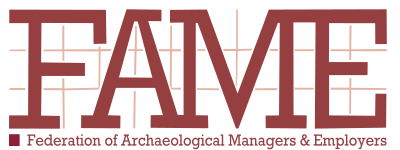
  • H&S Notice: Potentially hazardous exposure to chemicals: Crop Sprayer

    FAME H&S Notices are real-world examples of incidents, provided anonymously by FAME members, that highlight learning opportunities for the sector to improve our health and safety working.

    This notice concerns about possible exposure to chemicals through crop spraying. Download it here:

  • Making Your Archaeological Fieldwork Events More Accessible

    A free webinar on free and low-cost ways to make your community or development-led event more accessible that anyone can implement, including what information to include when advertising. The webinar with discuss what you should prioritise and offer suggestions with regards to what to ask for in your funding applications, crowdfunding campaigns or fundraising webpages if you’d like to make your event even more welcoming.

    The webinar will start with a presentation and will be followed by a Q&A session to cover any key issues or questions in more detail.

    This webinar is run by Dig It! and like past webinars it is not just for archaeologists based in Scotland, anyone can attend. Signing up is required and can be done at this link – https://www.eventbrite.co.uk/e/making-your-archaeological-fieldwork-events-more-accessible-tickets-167587640143

  • Opportunity: Collaborative Doctoral Awards

    The Scottish Graduate School for Arts & Humanities has introduced anew range of research opportunities, which aim to align research more closely with practice – A Collaborative Doctoral Awards scheme.

    NOTE: organisations do not need to be based in Scotland

    Collaborative Doctoral Awards provide funding for PhD-level research projects which are developed in partnership between Higher Education Institutions and non-HEI organisations or businesses. The funding is awarded to the HEI and the student receives a stipend.

    The awards are intended to encourage and develop collaboration and partnerships providing opportunities for doctoral students to gain first-hand experience of work outside the university environment and enhance the employment-related skills and training a research student gains during the course of their award.

    There is a small cost for hosts roughly £500 per year of the project.

    Find out the full details here: https://www.sgsah.ac.uk/partners/cda/#/whatarecollaborativedoctoralawards

  • FAME welcomes new member LS Archaeology

    FAME is pleased to announce that LS Archaeology has joined us.

    A professional archaeological contractor based in York who have been operating in and around Yorkshire for the last 10 years.

    Website: www.lsarchaeology.co.uk

    Instagram: www.instagram.com/lsarchaeology/?hl=en-gb