Championing Archaeological Businesses

Category: FAME News

  • Medication Side-Effects: Cold Sensitivity – update to FAME medication guide

    Medication Side-Effects: Cold Sensitivity – update to FAME medication guide

    We have updated the FAME Medication Side-Effects: Heat and Sun Sensitivity guide to now include cold sensitivity. The updated guide can be found on our website here: Medication Side-Effects: Heat, Cold and Sun Sensitivity and included below in this news item.

    Some medications can make it harder for people to regulate their body temperature and thus increase the risk of overheating. Or, the opposite issue, developing cold intolerance.  Additionally, some medications can cause photosensitivity, also known as ‘sun allergy’, a condition where the skin becomes extremely sensitive to ultraviolet light.

    We have created this guide because archaeologists have an elevated risk of these adverse reactions given the nature of some of our work – outdoors during hot and cold weather, though indoor work is not without risk. Moreover, employees do not normally have to disclose the medications they take so employers should always assume that they do not have full knowledge of their employees’ medical conditions and should regularly raise awareness of these issues with their employees i.e. share this guide with them. Most archaeologists are unlikely to be aware of these risks, or may have started a new medication and/or may not remember the risk associated with a specific medication; the lists in this guide are lengthy.

  • FAME Forum 2024 Videos

    The presentations at the 2024 FAME Forum were recorded and are now available to view below:

    FAME’s Carbon Calculator

    https://youtu.be/VcQK-SezkOo

    Changes to CSCS: Update and Planning for the Way Forward

    https://youtu.be/XMLt2f2onNQ

    Meet FAME members- York Osteoarchaeology

    https://youtu.be/sPlDPfSEgA0

    1966 and All That

    https://youtu.be/UKJQWLAQVgk

    Current developments in TII Archaeology and Heritage

    https://youtu.be/IYtc27Q1Af4

    Meet FAME members- Heritage Business International

    https://youtu.be/peQIzm2pdMk

    A New Model for Global Heritage Management

    https://youtu.be/51Ul2EZi8Uc

    Re-entering the Eurozone with old friends and new

    https://youtu.be/PUEaEqti1Rg

    Meet FAME members- Magnitude Surveys

    https://youtu.be/GrKNPcg-6Dg

    Update on the Archaeological Standard Method of Measurement

    https://youtu.be/xrcGTLEjkfg

    State of the Archaeological Market 2022-23

    https://youtu.be/rV0j725akZc

  • State of the Archaeological Market 2023

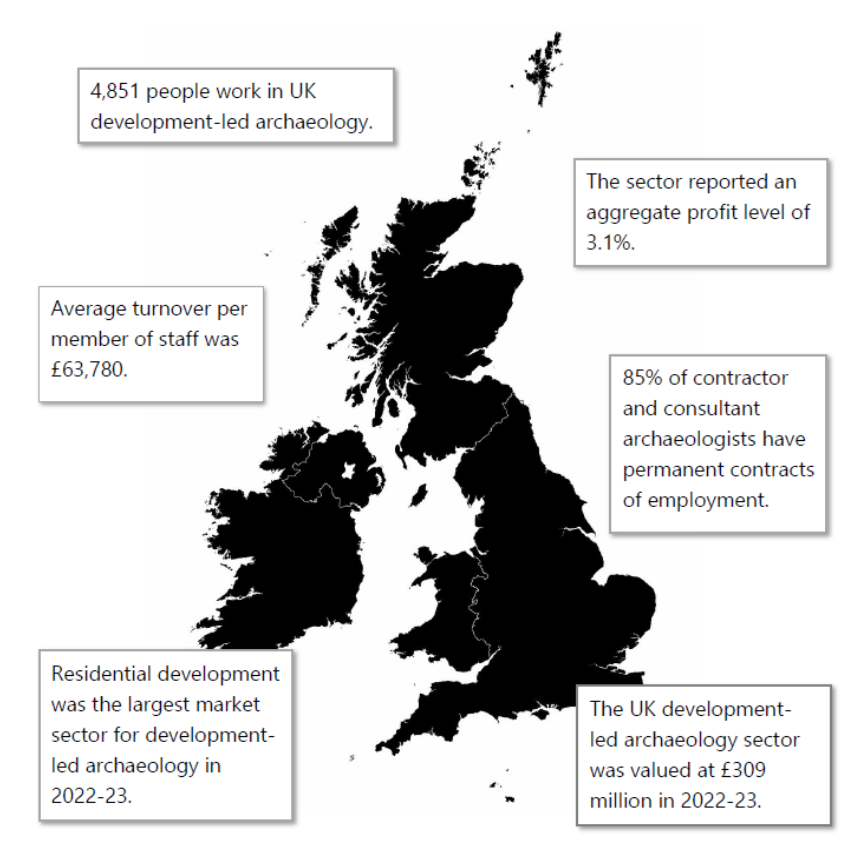
    We are proud to announce the publication of the 2023 State of the Archaeological Market Report. It presents the results of the survey for 2022-23, in the United Kingdom.

    Map the UK and Ireland with text boxes with headlines of the report.

    The overall aims of this survey are to provide:

    • a unique analysis of the archaeological sector as part of the overall economy;
    • statistics that allow estimation of total value of the sector to the economy;
    • data on indicative numbers of employed professional archaeologists working in the commercial sector with comparative figures for other areas;
    • data for analysis of long-term sustainability for the sector;
    • data that can enable informed lobbying to help protect heritage; and
    • data to support planning effectively for the future so that the industry is sustainable and results in a benefit for society.

    You can find and read the full report here:

    Past reports

    2022

    2021

    2020

    2019 

    2018

    2017

    2016

    2015

    2014

    Support

    This project was undertaken by the Federation of Archaeological Managers and Employers with support from the Chartered Institute for Archaeologists and Historic Environment Scotland.

  • Comments Open on The Archaeological Standard Method of Measurement

    The Federation of Archaeological Managers and Employers with support from the Chartered Institute for Archaeologists and funding from Historic England, has developed a Bill of Quantities (BQ) approach to procuring archaeological work.

    Predicting the quality and quantity of archaeological discoveries is not possible. Any quotations for archaeological excavations can only ever be estimates, with a high likelihood that some form of variation to an archaeological project will be required. The Royal Institution of Chartered Surveyors (RICS) advises the use of an approximate bill of quantities when ‘…there is great uncertainty in certain elements, such as major excavation and earthworks’.

    A bill of quantities is a process where tendering and payment is based on per unit costs of outcomes/tasks. In archaeology these units might be interventions (boreholes, trenches, sample collection, etc.), or volumes of soil, or features investigated (walls, postholes, graves, etc.), or quantities of artefacts (ceramics, flints, bones, etc.) or even the weight of artefacts. An approximate BQ in when the tendering is based on initial, estimated, quantities of those units, but as the project progresses the quantities are revised – called remeasurement by surveyors – and payment(s) are made based on those revised/remeasured quantities, so negating the need to initiate a contract variation.

    Such an approach benefits all involved by:

    • variations between the tendered and actual works undertaken are equitably adjusted thus ensuring the contractor is reimbursed accordingly, removing over-/under-estimating risks i.e. risk sharing;
    • saving the time/money of preparing bespoke project designs/bids;
    • presenting all tenders in a consistent manner, ensuring they are easy to compare, which saves tender commissioners the time/money spent trying to compare different bespoke proposals;
    • provides consistency, clarity and recognisable measures of output which can be tracked and verified against a programme of work;
    • reducing the risk of misinterpretation in pricing;
    • building trust between clients and contractors, because there is a framework to understand any cost increases or decreases.

    Essentially, it removes the guesswork from bidding, and conversely in analysing bids, together with decreasing opacity of project costs, while reducing risks and improving relationships/understanding.

    The Archaeological Standard Method of Measurement (ASMM) is a framework by which archaeological works can be priced and paid for through the use of a BQ. It is inspired by the RICS new rules of measurement (NRM). The ASMM is a suite of documents written to provide a set of measurement best practice methods that can be understood by anyone involved in an archaeological project.

    The ASMM has been developed with feedback from FAME members and organisations that commission archaeological work. We have completed a draft that should be usable in its current form but to ensure all concerns are addressed we are opening up a round of final comments on the documents. If you have any feedback on the suite of documents please email it to – info@famearchaeology.co.uk. By June 1st, 2024.

    There are two documents – the ASMM word document, which explains the main concepts of an archaeological bill of quantities and an excel spreadsheet which is the template BQ.

    Scope – who is this for?

    While it has been produced primarily with reference to the UK development and construction sectors, it is adaptable to archaeological work in different settings and different countries.

    These documents are for people commissioning or undertaking archaeological work. Specifically, those involved in the tendering, commissioning, monitoring of contracts and paying for work – on either side of those tasks.

  • CSCS Update

    CSCS Update

    On the 26th of January we learned that CSCS will no longer be issuing CSCS cards to archaeologists from Tuesday, 30th April 2024. Since then we have prioritised ensuring that FAME members will continue to have access to construction sites after that date.

    We have lobbied BuildUK, the trade association for the UK construction industry, to make sure that all of their members know that archaeologists will still need access to sites – as we will be there to help them discharge the planning conditions that have been placed on their projects. BuildUK today sent this message to all of their members:

    “CSCS has confirmed that archaeologists will no longer be able to apply for CSCS cards from 1 May 2024. Archaeology is not a construction occupation and, in line with the CLC recommendation on industry card schemes, CSCS does not issue cards for such occupations. Archaeologists should be able to access sites without a CSCS card to carry out their role, and Build UK’s Training Standard confirms that it is the responsibility of site managers to induct and escort non‐construction workers arriving on site so they can work safely.”

    BuildUK skills update 4th March 2024

    We hope no FAME members will encounter immediate issues with site access. In theory, site managers will not ask archaeologists to show their CSCS cards to get on site – but it might take time for this to become common knowledge and practice.

    If anyone does have difficulties, they can point the site manager towards that BuildUK news item – but to minimise the potential for this, we very definitely recommend that up until 30th April, FAME members continue to support their staff in acquiring CSCS cards – remembering that while new cards will not be issued after that date, existing cards will remain valid for up to five years. And as holding a CSCS card demonstrates that the holder has passed a CITB Health, Safety and Environment test, it will continue to be an externally benchmarked demonstration of that person’s competency in health and safety.

    Going forward, in the absence of the CSCS cards, FAME is working to identify what the best route to certify archaeologists’ health and safety competences will be. We know that FAME members’ staff have to be competent to be safe, and we need to be able to certify that. We are working towards providing you with an update on this in the summer.

    Kenneth Aitchison
    CEO FAME: Federation of Archaeological Managers and Employers

  • CSCS card being withdrawn from archaeologists

    CSCS card being withdrawn from archaeologists

    We have learned that CIfA has been notified that CSCS are making changes to the criteria governing the requirement to hold a valid CSCS card and that the AQP and PQP cards will not be issued to archaeologists in the future. We understand that the change is likely to take effect from 1 May and that cards will be required up to that point. After that archaeologists should not need a CSCS card to access construction sites.

    We are working with CIfA to find out:

    •     How BuildUK will ensure that their members have been informed – everyone is expecting some issues;
    •     Cards will be issued between now and 30 April 2024 – so we want to know if archaeologists (or their employers will) be incurring costs for five year certification that will only remain valid for a period of weeks.

    Note – we understand this is not negotiable with CSCS, we have been informed of the changes after the decision was made.

    The FAME H&S committee met on Friday to discuss. Generally everyone felt the tests have reduced in relevance for archaeologists – the PQP test had recently been rewritten to heavily focus on CDM, which is not relevant to archaeologists. However, the H&S committee is worried about access i.e. the fact that archaeologists don’t need the card might not be communicated too well. Moreover, there is concern how this will work with some passport schemes that require a CSCS card. At the moment we are in a holding pattern as we wait to hear back from CSCS. They want to put out an announcement this week, how likely that is, is unknown, we are still waiting on details. As soon as we know more, we’ll pass it along to you.


    Best wishes
    Kenneth, CEO of FAME

  • Memorandum of Understanding between FAME and CIfA

    Memorandum of Understanding between FAME and CIfA

    Both FAME and CIfA are pleased to announce that we have agreed an MoU and you can find it below and https://www.archaeologists.net/partnerships. CIfA and FAME wish to work collaboratively to maximise the positive influence each organisation has on the archaeological sector.

  • FAME Forum Presentation Recordings

    The recordings of the presentations from the FAME Forum have now been published. If you were not able to make it, or see the presentation you wanted, please find links to them below, for you to view at your pleasure:

    Health and Safety on Temporary Works https://youtu.be/HhYDWSsSVhw
    Temporary Works and Archaeology https://youtu.be/FYU8bexCL68
    A National Collection of Archaeological Archives https://youtu.be/zgnlk3cj87Y
    PUNS 2 – understanding what the public wants from archaeological interventions https://youtu.be/AIb5QpGMr2I
    NetZero for Archaeology https://youtu.be/42Uo3PpZp8A
    State of the Archaeological Market 2021-22 and Health & Safety Report 2021-22 https://youtu.be/Jj9dvU1sEGs
    Sustainability Agendas for Archaeological Contractors https://youtu.be/VL6mYeJdn-w
    Archaeological Achievement Awards: Celebrating Excellence in Archaeology https://youtu.be/nMfT_35ptCI
    King’s Award for Enterprise https://youtu.be/1kPOiCghvJI

  • State of the Archaeological Market 2022

    I am delighted to introduce the results of the annual State of the Archaeological Market Survey covering the financial year 2021-2. The gathered data are of great interest and use to archaeologists employed in many different types of organisations, and provide valuable statistics for wider application within industrial, governmental and political circles. Without these data the important role that we carry out in safeguarding our heritage, and the value that this work brings to the national economy and society, would be lost to policymakers and decision-makers.

    Some key points from this year’s survey are that archaeological practice has contributed £268 million to the economy, with Transport providing the stimulus for 39% of this total, and housing 32%. There has been a slight growth in the numbers employed in archaeology, and the majority of staff saw pay rise above or in line with inflation at around 7.1%. Average charge out rates rose slightly less at 6.3%, but average profit levels at 7% are reassuring as it shows the industry is operating a sustainable model, accumulating funds for investment. Indeed the majority of organisations are upskilling and training staff, and this combined with a tight labour market, makes it essential for organisations to have attractive employment packages to recruit and retain staff. Nonetheless, there is a significant minority of respondents who made a loss during the financial year (17%), or whose profit margin was below 5% (46%), and this suggests a large differential between profitable and non-profitable organisations. As an industry we need to address this disparity, and encourage those returning low profits to amend their charging structures so they can plan effectively for a sustainable future.

    Additional topics have also been covered by this survey. The annual Health & Safety audit is reported separately, but questions over the quantity of archive materials being stored at the expense of the responding organisations because there is no facility that will curate them, no museum or store where the archives can be deposited, is very concerning. This issue has been raised by FAME as a major problem since 2012, and we have been actively working with partners to find solutions. The answers provided show each respondent had hundreds of archives, costing them thousands of pounds each year, which it is not their remit or appropriate for them to do. The data should assist Historic England with their campaigning for a national archaeological archive repository to be created. In addition, the data gathered over what relationships exist between commercial practice and university departments of archaeology, should allow greater collaboration and mutual benefit to be developed for the future.

    I trust you find this well-presented report of interest and value, and I wish to extend my thanks to the authors and coordinators of the survey for their clarity and tenacity in extracting such worthwhile results from the complex data that have been gathered.

    Tim Malim

    Chair of FAME

  • FAME Forum Schedule

    We are happy to announce the schedule for the FAME forum. It is still possible to book tickets here: https://www.eventbrite.com/e/fame-forum-agm-2023-tickets-616512474407

    Schedule:

    09:00 – 09:50 Tea and Coffee

    09:50 – 10:00 Welcome – Tim Malim (Chair, FAME)

    10:00 – 10:45 Health and Safety on Temporary Works – David McNair (Temporary Works Forum) & Luke Brannlund (Cotswold Archaeology)

    10:45 – 11:15 A National Collection of Archaeological Archives – Manda Forster (DigVentures) & Sam Paul (Sam Paul Heritage)

    11:15 – 11:45 PUNS 2 – understanding what the public wants from archaeological interventions – Neil Redfern (Council for British Archaeology) & Guy Hunt (MOLA)

    11:45 – 12:15 NetZero for Archaeology – Dan Miles (Historic England)

    12:15 – 12:45 State of the Archaeological Market 2021-22 and Health & Safety Report 2021-22 – Kenneth Aitchison (FAME) & Doug Rocks-Macqueen (FAME)

    12:45 – 14:00 Lunch

    14:00 – 14:45 Sustainability Agendas for Archaeological Contractors – Chris Springett (Spring Environmental)

    14:45 – 15:15 Considerate Constructors Scheme – Paige Athow (Considerate Constructors Scheme)

    15:15 – 15:30 Tea and Coffee Break

    15:30 – 16:30 Awards for Archaeological Companies. A panel discussion following brief presentations from Neil Redfern (Council for British Archaeology), Clive Waddington (Archaeological Research Services), Paige Athow (Considerate Constructors Scheme) & Aisling Fitzpatrick-Sinclair (Headland Archaeology)

    16:30 close