Championing Archaeological Businesses

Category: Resources

  • Radiocarbon Training: New Radiocarbon Database for Britain & Ireland

    There is an opportunity for free training on the new, live radiocarbon database for Britain and Ireland; the first repository of its kind.

    This hybrid training day works through the lifecycle of radiocarbon data, from sample selection right to deposition. It will provide a practical introduction to the new radiocarbon database as a research tool, with a focus on Scottish data, including an introduction to analysing results. There will be dedicated time for Q&A throughout.

    DETAILS
    When: 22nd October 2026, 10am–3pm

    Where: In person at the Engine Shed (Forthside Way, Stirling, FK8 1QZ), or join online
    (hybrid session)

    Cost: Free

    Booking: https://www.eventbrite.co.uk/e/radiocarbon-training-new-radiocarbon-database-for-britain-and-ireland-tickets-2002022196282?aff=oddtdtcreator

    Category: Research, Developer-led archaeology

    Event type: Learning session

    Level: Quite technical

    Audience: Developer-led and academic archaeologists, local and national government curators, museum staff, archivists, data managers, postgraduate researchers, and members of local societies

    Time: 10am to 3pm

    OVERVIEW

    Radiocarbon dating is central to how we understand the past. Every year, thousands of results are produced. Yet until now, these data have often been scattered, hard to find, or at risk of being lost altogether, with no single agency officially responsible for safeguarding. Project Radiocarbon changes that — led by academics at Manchester Metropolitan University and University College Dublin and working with partners including Historic Environment Scotland, Historic England, and heritage bodies across Ireland — it brings together 35,000+ dates from across Ireland and Britain into one open, searchable, map-based repository.

    If you work in or research archaeology or heritage this is your chance to see how the
    new system makes data more visible, more useful, and permanently safeguarded.

    Learning outcomes
    By the end of this session, participants will be able to:

    • Understand the principles of radiocarbon dating, and how to select appropriate
      samples for reliable results,
    • Understand how Bayesian statistical analysis can combine ¹⁴C dates with site-
      stratigraphic, phasing and other chronological information to produce more
      precise chronologies,
    • Search and navigate the Project Radiocarbon repository using its interactive
      map-based interface, search by period, site type, or geographic scale, and
      understand how tools like Period reconcile different regional terminologies,
    • Contribute to the development of the practical process and standards for
      submitting new radiocarbon results to Historic Environment Scotland via the
      repository,
    • Apply the repository’s resources to their own research, heritage management, or
      public engagement work.


    Who should attend?

    Archaeologists and heritage professionals working with radiocarbon
    dates in planning/infrastructure projects.

    Curatorial and planning archaeologists in local authorities and heritage
    agencies

    Academic researchers and postgraduate students

    Museum and government heritage staff

    Anyone in Scotland’s archaeology sector curious about the new
    repository

    Fees

    Spaces are free but limited — sign up via Eventbrite to secure your place.

    Schedule

    10am-10.15am Introduction
    10.15am-11am Session 1. Intro to 14C and best practices in sample selection
    11am-11.30am coffee
    11.30am-12.15pm Session 2. Bayesian analysis
    12.15pm-1pm lunch (find your own. Attendees are welcome to bring things and sit and
    eat in the auditorium)
    1pm-1.45pm Session 3. Using the database – worked examples.
    1.45pm-2.30pm Session 4. Depositing results with HES
    2.30-3pm Q and A
  • Resources for Explaining HERs

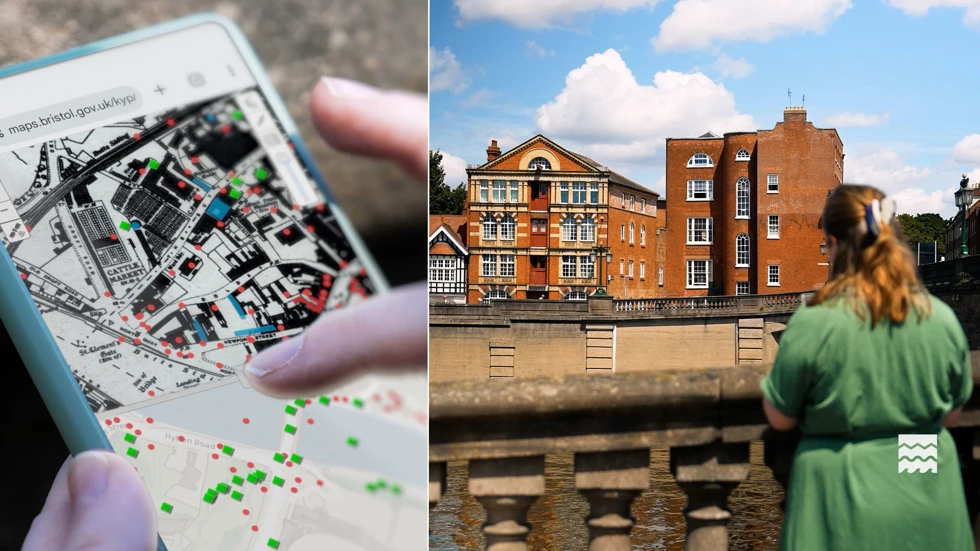
    Many times, we get questions from the public and our clients about archaeological processes and resources, one of which is about HERs. There is a new resource available to help with that; short video explainers. Produced by Historic England and involving the HER community up and down England, you can find the videos here: https://historicengland.org.uk/advice/technical-advice/information-management/hers/#films

  • New Edition of First Aid for Finds

    A new, fourth edition, of the First Aid for Finds has been published. The first edition of First Aid for Finds was published fifty-three years ago, and the fourth edition is a welcome update. Moreover, it is a digital version now, which you can find here: https://www.firstaidforfinds.org/

  • The Benefits of Development-led Archaeology

    The European Archaeological Council (Europae Archaeologiae Consilium), a membership organisation consisting of the national bodies charged with the management of the archaeological heritage throughout Europe, has released another guide – The Benefits of Development-led Archaeology – that we believe our members will be interested in:

    https://zenodo.org/records/10696865

    “This report presents nine tangible public benefits which can be derived from development-led archaeological investigation, illustrated by genuine case studies from across Europe and beyond. It is designed to act as a resource for all archaeological heritage managers, archaeologists, and other stakeholders to help make the case for supporting development-led archaeology, and to help shape investigation projects to get the most out of them for the public. It recognises that the benefits of archaeology go far beyond its inherent value in creating knowledge about our shared past, creating many other societal and scientific benefits. It demonstrates very small additional cost of development-led archaeology at the state level, and concludes that this cost is outweighed by the positive benefits which can be realised if planned into projects from the outset.”

  • The Value of Developing a Research Framework

    The European Archaeological Council (Europae Archaeologiae Consilium), a membership organisation consisting of the national bodies charged with the management of the archaeological heritage throughout Europe, has released a new guide – The Value of Developing a Research Framework. Given the the extensive use of Research Frameworks by FAME members we believe this will be of use to our members, especially, those interest in developing more local and thematic research Frameworks.

    “This document provides the strategic context that supports the value and role of research frameworks in fostering a coordinated research culture and embedding a research/evidence-based approach that underpins heritage management, regardless of the different political, legal, administrative and economic contexts of individual states. This includes supporting decision making and broadening public benefit to include social and communal values as well as the research dividend. The document is aimed at those people who are responsible for commissioning, funding or developing research frameworks. It can be used to support the creation of a business case for developing a research framework, and sets out the key principles that should be considered in doing so.”

    https://zenodo.org/records/10696980

  • State of the Archaeological Market 2023

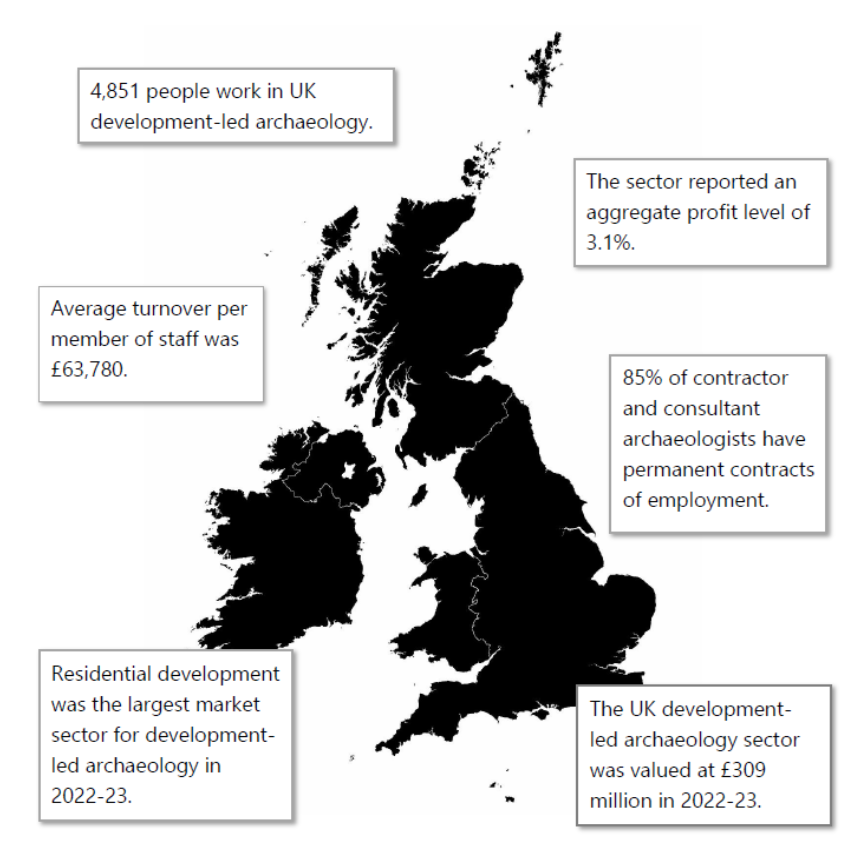
    We are proud to announce the publication of the 2023 State of the Archaeological Market Report. It presents the results of the survey for 2022-23, in the United Kingdom.

    Map the UK and Ireland with text boxes with headlines of the report.

    The overall aims of this survey are to provide:

    • a unique analysis of the archaeological sector as part of the overall economy;
    • statistics that allow estimation of total value of the sector to the economy;
    • data on indicative numbers of employed professional archaeologists working in the commercial sector with comparative figures for other areas;
    • data for analysis of long-term sustainability for the sector;
    • data that can enable informed lobbying to help protect heritage; and
    • data to support planning effectively for the future so that the industry is sustainable and results in a benefit for society.

    You can find and read the full report here:

    Past reports

    2022

    2021

    2020

    2019 

    2018

    2017

    2016

    2015

    2014

    Support

    This project was undertaken by the Federation of Archaeological Managers and Employers with support from the Chartered Institute for Archaeologists and Historic Environment Scotland.

  • Comments Open on The Archaeological Standard Method of Measurement

    The Federation of Archaeological Managers and Employers with support from the Chartered Institute for Archaeologists and funding from Historic England, has developed a Bill of Quantities (BQ) approach to procuring archaeological work.

    Predicting the quality and quantity of archaeological discoveries is not possible. Any quotations for archaeological excavations can only ever be estimates, with a high likelihood that some form of variation to an archaeological project will be required. The Royal Institution of Chartered Surveyors (RICS) advises the use of an approximate bill of quantities when ‘…there is great uncertainty in certain elements, such as major excavation and earthworks’.

    A bill of quantities is a process where tendering and payment is based on per unit costs of outcomes/tasks. In archaeology these units might be interventions (boreholes, trenches, sample collection, etc.), or volumes of soil, or features investigated (walls, postholes, graves, etc.), or quantities of artefacts (ceramics, flints, bones, etc.) or even the weight of artefacts. An approximate BQ in when the tendering is based on initial, estimated, quantities of those units, but as the project progresses the quantities are revised – called remeasurement by surveyors – and payment(s) are made based on those revised/remeasured quantities, so negating the need to initiate a contract variation.

    Such an approach benefits all involved by:

    • variations between the tendered and actual works undertaken are equitably adjusted thus ensuring the contractor is reimbursed accordingly, removing over-/under-estimating risks i.e. risk sharing;
    • saving the time/money of preparing bespoke project designs/bids;
    • presenting all tenders in a consistent manner, ensuring they are easy to compare, which saves tender commissioners the time/money spent trying to compare different bespoke proposals;
    • provides consistency, clarity and recognisable measures of output which can be tracked and verified against a programme of work;
    • reducing the risk of misinterpretation in pricing;
    • building trust between clients and contractors, because there is a framework to understand any cost increases or decreases.

    Essentially, it removes the guesswork from bidding, and conversely in analysing bids, together with decreasing opacity of project costs, while reducing risks and improving relationships/understanding.

    The Archaeological Standard Method of Measurement (ASMM) is a framework by which archaeological works can be priced and paid for through the use of a BQ. It is inspired by the RICS new rules of measurement (NRM). The ASMM is a suite of documents written to provide a set of measurement best practice methods that can be understood by anyone involved in an archaeological project.

    The ASMM has been developed with feedback from FAME members and organisations that commission archaeological work. We have completed a draft that should be usable in its current form but to ensure all concerns are addressed we are opening up a round of final comments on the documents. If you have any feedback on the suite of documents please email it to – info@famearchaeology.co.uk. By June 1st, 2024.

    There are two documents – the ASMM word document, which explains the main concepts of an archaeological bill of quantities and an excel spreadsheet which is the template BQ.

    Scope – who is this for?

    While it has been produced primarily with reference to the UK development and construction sectors, it is adaptable to archaeological work in different settings and different countries.

    These documents are for people commissioning or undertaking archaeological work. Specifically, those involved in the tendering, commissioning, monitoring of contracts and paying for work – on either side of those tasks.

  • Rock Art Short Guide

    Scotland’s Archaeology Strategy has launched a new guide – Identifying and Recording Scotland’s Prehistoric Rock Art. This was produced off the back of the successful completion of Scotland’s Rock Art Project . The guide describes techniques for locating, identifying and recording rock art and is aimed more at students, community groups, and individuals that are interested in this area of archaeology, but will also be of interest to professionals as well.

    The Short Guides are issued under an Open Government Licence so anyone can download, host a copy on their own website or share however they wish.

    This is the second a new suite of guidance that is being delivered as part of Scotland’s Archaeology Strategy. You may remember the first which came out last year, about lithic scatters, authored by Caroline Wickham-Jones. The Recognition and Investigation of Lithic Scatter Sites in Scotland .

    The Archaeology Short Guides will be a new series of best practice guides and how-tos on a range of subjects about Scottish Archaeology. You will be aware of Managing Change in the Historic Environment, which these are not intended to replace. Managing change sits under Scottish Planning Policy and HEPS and has a formal status in that regard, and is all about informing changes to the historic environment. The short guides will be equivalent to the old HS technical advice notices (TAN), if you remember them, and are more guidance about techniques or specialist subject areas in Archaeology.

    Important to note that although hosted and delivered by HES, these are very much a strand of Scotland’s Archaeology Strategy.

  • FAME Forum Presentation Recordings

    The recordings of the presentations from the FAME Forum have now been published. If you were not able to make it, or see the presentation you wanted, please find links to them below, for you to view at your pleasure:

    Health and Safety on Temporary Works https://youtu.be/HhYDWSsSVhw
    Temporary Works and Archaeology https://youtu.be/FYU8bexCL68
    A National Collection of Archaeological Archives https://youtu.be/zgnlk3cj87Y
    PUNS 2 – understanding what the public wants from archaeological interventions https://youtu.be/AIb5QpGMr2I
    NetZero for Archaeology https://youtu.be/42Uo3PpZp8A
    State of the Archaeological Market 2021-22 and Health & Safety Report 2021-22 https://youtu.be/Jj9dvU1sEGs
    Sustainability Agendas for Archaeological Contractors https://youtu.be/VL6mYeJdn-w
    Archaeological Achievement Awards: Celebrating Excellence in Archaeology https://youtu.be/nMfT_35ptCI
    King’s Award for Enterprise https://youtu.be/1kPOiCghvJI

  • Survey: Integration of Early Career Archaeologists: Contract, Commercial, Consulting and Specialists

    The Early Careers in Archaeology task force, on behalf of the European Association of Archaeologists, has launched a survey that aims to make an inventory of challenges and opportunities of Early Career Archaeologists (ECAs) working in a wide range of positions outside of academic archaeology. The focus of this survey is on ECA experiences but they welcome responses from all archaeologists and from those who do not work in traditional academic settings in archaeology which might include, but are not limited to: commercial, contract, consulting, heritage, museums, and other specialist fields including post-excavation and associated laboratory or desk work as well as those who formerly worked in these settings but have left archaeology. The survey can be found here:

    https://docs.google.com/forms/d/e/1FAIpQLSeAllKJ-oOod1fxwmrTqKzF3e-URAHMOFZQ633pjWmKuOPQGg/viewform