A presentation from our former CEO on some of the findings of the recently published State of the Archaeological Market Survey, given at the FAME Forum:
Author: Doug Rocks-Macqueen
-
Meet FAME members – SUMO Geosurveys
At the FAME Forum, FAME members give small presentations about themselves to tell us about the work they do. At the last FAME Forum, Claire Rose presented on SUMO Geosurveys and you can see her presentation here:
-
Political Outlook for Archaeology
At the FAME Forum Rob Lennox (CIfA) presented on the ‘tea leaves’ of UK politics for archaeology. This presentation was recorded and is now online for you to view:
-
H&S Notice: Lyme Disease and Autumn Tick Peak
FAME H&S Notices are real-world examples of incidents, provided anonymously by FAME members, that highlight learning opportunities for the sector to improve our health and safety working. This one involves Lyme Disease:
-
2024-25 State of the Archaeological Market Report
We, with the support of the Chartered Institute for Archaeologists (CIfA), have conducted another State of the Archaeological Market survey, and the results are now available in a report, published below.
The report provides a wealth of information on the size and nature of the archaeology market in the UK and its contribution to the wider economy, generating statistics that allow an estimation of the total value of the sector to the economy. This data helps to forecast future demand for archaeological services, and deepens understanding of the sector, which enables us (FAME and CIfA) to target resources and support our members, as well as highlighting the valuable contribution archaeology makes to society. Some key highlights:
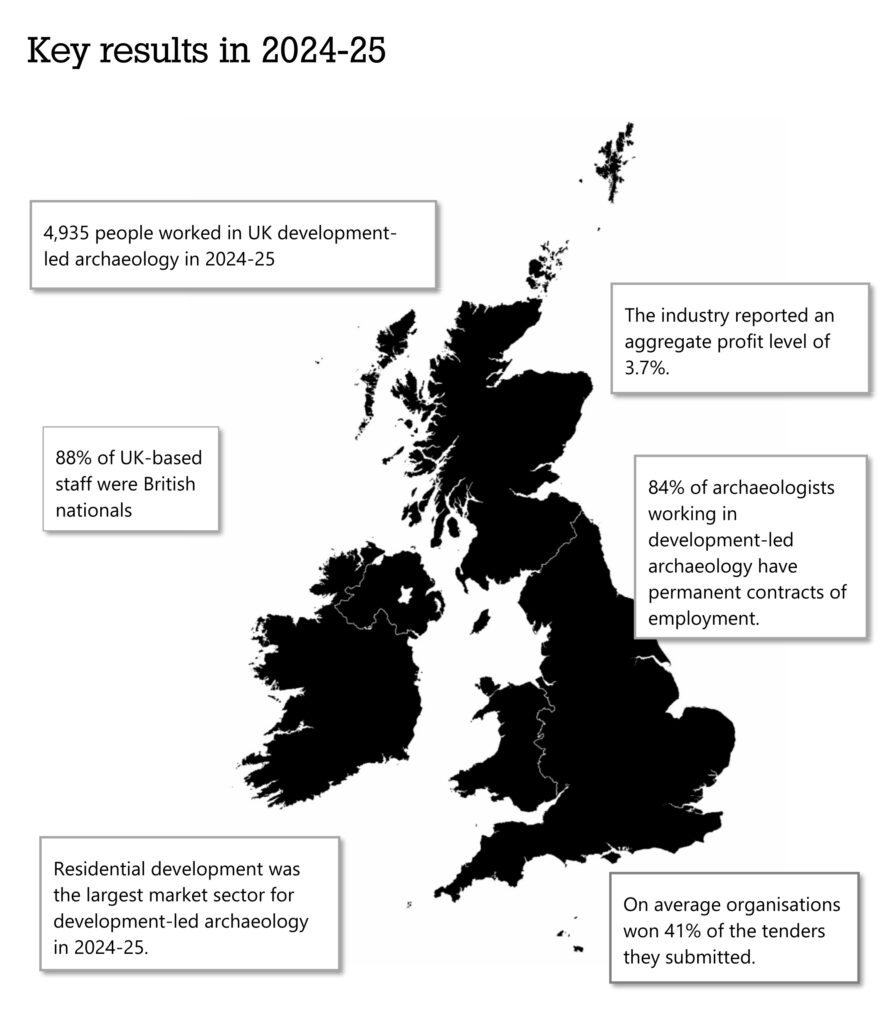
You can download the full report here:
-
Our Past, Our Future Call for Case Studies: Heritage, History and Wellbeing in Scotland Demonstrator Programme
A request from HES:
“Historic Environment Scotland and the University of Birmingham are gathering examples of organisations, projects and individuals across Scotland using history and heritage, including intangible heritage, to improve people’s wellbeing.
The University of Birmingham has been commissioned by Historic Environment Scotland to build a database of case studies to support Our Past, Our Future (Scotland’s strategy for the historic environment) and demonstrate how the heritage sector contributes to Scotland’s wider national priorities, including health and wellbeing.
Selected examples will be showcased on the Our Past, Our Future website, providing real-world evidence of the value of heritage to wellbeing for partners, policymakers, and funders.
We would value your input in helping us build a database that reflects the full breadth and diversity of heritage and wellbeing work across Scotland. Whatever shape your work takes – big or small, well-established or just starting out, backed by formal evaluation or anecdotal evidence (such as talking to your participants) that shows it’s making a difference – we want to hear about it!
Any organisation, project, or individual working in or with Scotland’s historic environment or heritage sector, including:
- Heritage sites, museums, and archives
- Community heritage groups and trusts
- Arts and culture organisations working with heritage themes
- Health, social care, or wellbeing services partnering with heritage projects
- Local authorities and place-based initiatives
We’re especially interested in examples that show one or more of the below:
- Show a clear link between a heritage activity and a wellbeing outcome (e.g. reduced isolation, improved mental health, stronger community connection, increased sense of purpose or belonging)
- Include real people’s experiences – quotes, stories, or reflections from participants where possible
- Can be illustrated with photographs (with permission to use them)
- Have tried to measure or evidence social value, wellbeing, or wider outcomes using a specific methodology or data collection approach — whether or not it worked as hoped. Understanding what’s already been tried, and what you learned from it, is just as valuable to us as a polished success story!
Don’t have a fully-formed case study yet? Tell us anyway!
We also want to hear from you if you believe your activity generates positive outcomes for wellbeing, even if you don’t currently have evidence or a fully developed case study. Many organisations have anecdotal evidence of impact and that’s valuable too.
We’ll ask you to share
- A short description of your project or activity (what you did, where, who was involved)
- The wellbeing outcome or change you observed, and how you measured this (including any methodology or approach you used, even informally)
- Any supporting evidence, feedback, or quotes from those involved
- Photographs or other visual material, if available (please only submit images you have permission to share)
- Your organisation’s/project’s name and a contact person
How to submit
Online form: https://app.onlinesurveys.
jisc.ac.uk/s/bham/hes- heritage-and-wellbeing-in- scotland-examples Deadline for submissions: 9th October
If you have any questions, please get in touch with Dr Amy Luck, University of Birmingham at a.luck.1@bham.ac.uk.
We look forward to hearing about your work!”
-
Radiocarbon Training: New Radiocarbon Database for Britain & Ireland
There is an opportunity for free training on the new, live radiocarbon database for Britain and Ireland; the first repository of its kind.
This hybrid training day works through the lifecycle of radiocarbon data, from sample selection right to deposition. It will provide a practical introduction to the new radiocarbon database as a research tool, with a focus on Scottish data, including an introduction to analysing results. There will be dedicated time for Q&A throughout.
DETAILS
When: 22nd October 2026, 10am–3pmWhere: In person at the Engine Shed (Forthside Way, Stirling, FK8 1QZ), or join online
(hybrid session)Cost: Free
Category: Research, Developer-led archaeology
Event type: Learning session
Level: Quite technical
Audience: Developer-led and academic archaeologists, local and national government curators, museum staff, archivists, data managers, postgraduate researchers, and members of local societies
Time: 10am to 3pm
OVERVIEW
Radiocarbon dating is central to how we understand the past. Every year, thousands of results are produced. Yet until now, these data have often been scattered, hard to find, or at risk of being lost altogether, with no single agency officially responsible for safeguarding. Project Radiocarbon changes that — led by academics at Manchester Metropolitan University and University College Dublin and working with partners including Historic Environment Scotland, Historic England, and heritage bodies across Ireland — it brings together 35,000+ dates from across Ireland and Britain into one open, searchable, map-based repository.
If you work in or research archaeology or heritage this is your chance to see how the
new system makes data more visible, more useful, and permanently safeguarded.Learning outcomes
By the end of this session, participants will be able to:- Understand the principles of radiocarbon dating, and how to select appropriate
samples for reliable results, - Understand how Bayesian statistical analysis can combine ¹⁴C dates with site-
stratigraphic, phasing and other chronological information to produce more
precise chronologies, - Search and navigate the Project Radiocarbon repository using its interactive
map-based interface, search by period, site type, or geographic scale, and
understand how tools like Period reconcile different regional terminologies, - Contribute to the development of the practical process and standards for
submitting new radiocarbon results to Historic Environment Scotland via the
repository, - Apply the repository’s resources to their own research, heritage management, or
public engagement work.
Who should attend?Archaeologists and heritage professionals working with radiocarbon
dates in planning/infrastructure projects.Curatorial and planning archaeologists in local authorities and heritage
agenciesAcademic researchers and postgraduate students
Museum and government heritage staff
Anyone in Scotland’s archaeology sector curious about the new
repositoryFees
Spaces are free but limited — sign up via Eventbrite to secure your place.
Schedule
10am-10.15am Introduction
10.15am-11am Session 1. Intro to 14C and best practices in sample selection
11am-11.30am coffee
11.30am-12.15pm Session 2. Bayesian analysis
12.15pm-1pm lunch (find your own. Attendees are welcome to bring things and sit and
eat in the auditorium)
1pm-1.45pm Session 3. Using the database – worked examples.
1.45pm-2.30pm Session 4. Depositing results with HES
2.30-3pm Q and A - Understand the principles of radiocarbon dating, and how to select appropriate
-
FAME: a platform for collaborative improvement
Our secretariat and chair have recently written an article for CIfA’s The Archaeologist publication, which we are happy to share with you. It was for a themed issue on collaboration and covers how FAME has collaborated with others to improve the archaeological sector. We hope you enjoy reading it.
-
Developing resources to support historic environment sector apprenticeships
If you’re an employer in the historic environment sector and you’re wondering whether you could take on an apprentice, but don’t know where to start, CIfA is providing support.
CIfA is working with employers across the sector to develop a suite of resources to support companies who want to deliver apprenticeships in the sector but are struggling to take the next steps.
These resources include a template business case to make the case for supporting an apprenticeship to decision-makers, a step-by-step guide to setting up an apprenticeship, and guidance on designing an appropriate training programme. They are also developing case studies from employers who have successfully hosted apprentices, and are running a series of online support sessions to link employers with training providers – with dates and details listed below.
The project is funded by Historic England, and resources are focussed on English employers initially, but will be moving north of the border shortly, thanks to funding from Historic Environment Scotland, where a Modern Apprenticeship is also under development.
The online support sessions will give you the chance to meet representatives of the colleges delivering the training, ask questions and hear about the advice and support that’s available to you. Best of all, they are completely free.
All drop-in sessions are on-line, via Teams. To book, please follow the links below:
-
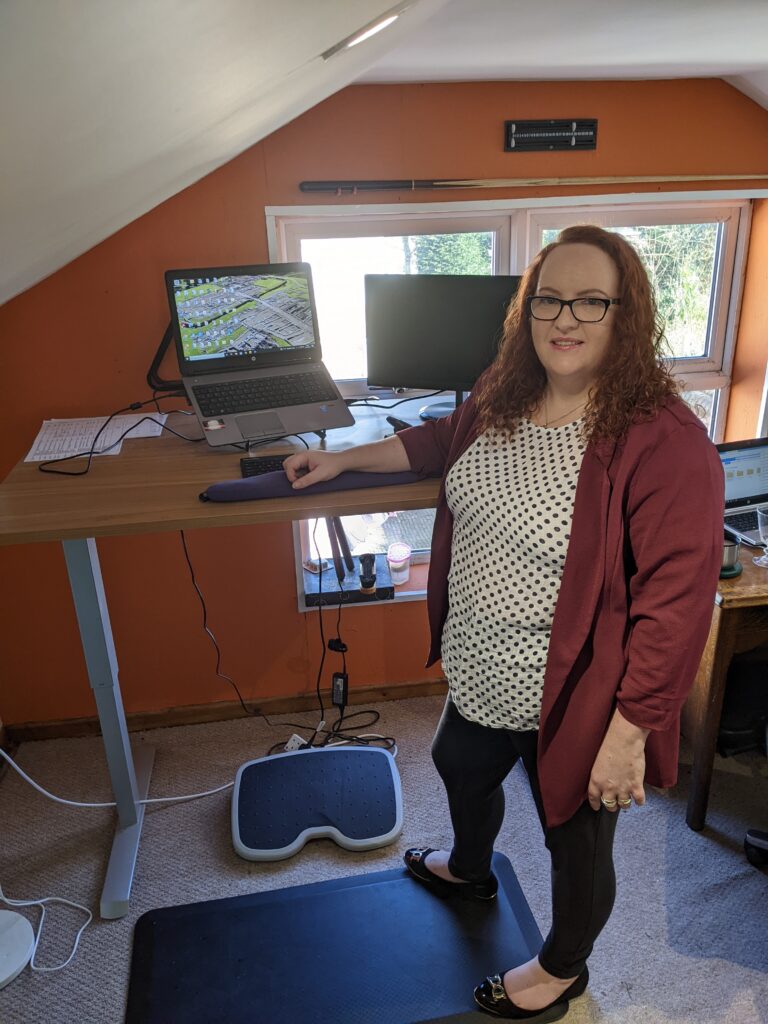
Call for reasonable adjustments at work images
Sarahjayne Clements, a doctoral candidate at the University of Hertfordshire is seeking help from individuals and employers to provide images of reasonable adjustments you may have had at work due to disability or images of reasonable adjustments you have given as an employer.
You must have the correct permissions, and the images will be used in her guide to employing disabled people in the heritage sector.
If you can help, please email: s.clements3@herts.ac.ukThese could be examples that have worked well or not. Also of interest are items provided through Access to Work or alternative funding.
As a positive example, please see the setup below for working from home with a sit-stand desk, a footrest, and an anti-fatigue mat.