Championing Archaeological Businesses

Author: Doug Rocks-Macqueen

  • Construction (Design and Management) Regulations 2015 – Advice for Archaeological Practitioners

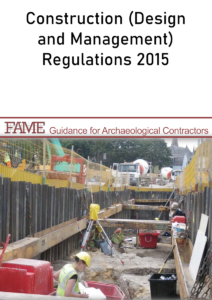
    Construction (Design and Management) Regulations 2015 – Advice for Archaeological Practitioners

    The FAME Health and Safety group has been working on creating advice for FAME members on a range of issues. We are happy to announce the publication of our advice on Construction (Design and Management) Regulations 2015.

    Key Take Away

    “Both FAME and the HSE discourage archaeologists from undertaking a role automatically, or by default, for which they may not be qualified, and which may result in significant health and safety and commercial risk.”

    The principal author of this paper was Luke Brannlund (Cotswold Archaeology) with input from other members of the FAME Health and Safety Working Group. FAME is very grateful to Russell Adfield and his colleagues at the HSE for the advice they gave during the production of this paper.

    Our guides rarely change but occasional updates do occur and it is best to check this page for the most recent version.

    The guide has been updated to version 3. June 2024.

  • COVID security to retain construction’s ‘essential’ status

    Dear FAME members,

    As you will be aware the various government authorities that we operate in have issued guidance on construction work during the most recently imposed restrictions:

    England – the recent (11January 2021) letter from the Rt Hon Kwasi Kwarteng MP Secretary of State at BEIS confirming the construction sector’s continuing ‘essential’ role:

    “firms and tradespeople in the construction sector and its supply chain [my emphasis], including merchants, suppliers and product manufacturers, should continue to operate during this national lockdown”

    Northern Ireland’s guidance is in effect until 6 February, but will be reviewed on 21 January (we do not anticipate it changing). https://www.nidirect.gov.uk/articles/coronavirus-covid-19-regulations-guidance-what-restrictions-mean-you

    In Wales, new guidance was issued on 23 December  – https://gov.wales/construction-and-outdoor-work-coronavirus-workplace-guidance-html

    For Scotland, the guidance has not changed since the summer –https://www.gov.scot/publications/coronavirus-covid-19-construction-sector-guidance/

    In the UK, across all nations, construction and its supply chain, i.e. us, are to continue working. Though from the 8th of January it has been shut down in the Republic of Ireland except for essential work: https://www.gov.ie/en/publication/2dc71-level-5/#construction

    Which means the following is only for those of you operating in the UK. We have been told that this continued work is predicated on the industry continuing to operate in a COVID secure way.

    As such, FAME advises that new CLC Site Operating Procedures version seven https://www.constructionleadershipcouncil.co.uk/wp-content/uploads/2021/01/Site-Operating-Procedures-Version-7.pdf

    sets the appropriate minimum for on-site work, supported by working advice produced by Prospect (COVID-19 Working Advice V1.1 04/05/2020) as guidance to undertake risk assessments and to implement appropriate measures to ensure safe working practices.

    Though members in Scotland should also use this guidance, in effect from January 11th,  https://www.cs-ic.org/constructionscotland/resources/working-on-site-during-the-covid-19-pandemic-construction-guidance/

    Furthermore, we would like to highlight the Social Distancing for Archaeology (SoDA) Toolkit (https://soda-toolkit.info/ ) as a resource for you. A recording of the FAME webinar Working with COVID restrictions in Archaeology. A review of the Social Distancing for Archaeology (SoDA) Toolkit is accessible to all at https://youtu.be/TnvrIofWeZs.


    Kenneth Aitchison

    CEO FAME

  • Profiling the Profession Deadline January 17th

    The Profiling the Profession survey deadline is this Sunday, January 17th.

    This is a very important survey covering topics from health and safety to income sources. FAME is a partner in this project, as the data for our State of the Archaeological Market and Health & Safety in Archaeology reports are being collected through this single exercise. It would be appreciated if you could share this message with all your members of staff, and invite them to complete the Survey for Individuals below.

    The project webpage is https://profilingtheprofession.org.uk/

    And here are the links to the two surveys

    Survey for Organisations

    • responding on behalf of an organisation including sole traders

    Survey for Individuals

    • individual archaeologists, whether employed, self-employed or unemployed
    • former archaeologists
    • archaeology students
  • FAME Supports Seeing Red

    FAME Supports Seeing Red

    FAME, the trade association for archaeology in the UK and Ireland, has teamed up with the Seeing Red project to provide all FAME member organisations with period packs – the size small first aid kits and just as important. These kits contain essential supplies to deal with menstruation for archaeologists out in the field or in the office, from packs of tissues to waste bags to various types of tampons and pads. These packs help employers and individuals to deal with issues of menstrual health and hygiene on sites, as well as contributing to tackling period poverty.

    Seeing Red is a menstruation revolution for archaeology, fieldwork and heritage industries. Run by archaeologist Amy Talbot, the initiative is promoting better menstrual health and hygiene on sites, equipping staff with the confidence to talk to site management about periods, and enabling management to deal appropriately with menstruation on sites. Seeing Red recognises that it is not only cis women that menstruate and is open to support all who could be affected by menstruation.

    Our CEO, Kenneth Aitchison, had this to say about the project, ‘It is amazing to see what Seeing Red has achieved since it was launched a year ago. FAME champions health, safety and hygiene in archaeology and the FAME Board of Directors was pleased to unanimously agree to fund the provision of period packs to all our members’.

    Amy Talbot, ‘Until now I have been creating the packs using my own funds and a small anonymous £50 donation, so it was great that FAME stepped forward to help fund the provision of packs to their members who make up so much of the development-led, commercial archaeology sector. I hope even more archaeological organisations will now come forward to provide their staff, students and volunteers with the packs.’

    In addition to the period packs, Seeing Red has also produced, a guide, costings and a set of answers to common questions. All of these can be found on the Seeing Red page of the Mentoring for Womxn in Archaeology and Heritage website https://mentorwomxn.org/2020/06/05/seeing-red/
    If you would like to discuss the Seeing Red initiative or to donate to support their work, please contact Amy at amymentoringwomeninarch@gmail.com.

  • The provision of hygiene bins and disposal of contents on archaeology sites

    The recording of our final FAME webinar of 2020 is now available:

    Recording: https://youtu.be/HMjZBriffoc

    This webinar will examine the legislation and regulations that cover provision of hygiene bins and disposal of contents. The speaker will mention why the Brilliant Bin system fits that legislation but principally it will be to advise what the range of options are.

    Delivered by Susan Hofgartner, of Brilliant Bins, who started work as an accountant and working at board level in various SMEs. Managing finance and administration in these companies, she inevitably got involved in the contracts for the hygiene bins. That convinced her that there must be a better way to deal with this issue. In 2008 she started working on the project and submitted patent applications for the long-life disposable bins, followed by launching them in 2010.

    WM3 Guidance on the classification and assessment of waste (1st Edition v1.1 ) Technical Guidance

    https://www.gov.uk/government/publications/waste-classification-technical-guidance

    See Example 4 at the end of Section A, page A42

    Workplace (Health, Safety and Welfare) Regulations 1992

    https://www.hse.gov.uk/pubns/priced/l24.pdf

    Particularly:

    Regulation 3 – Construction Sites

    Regulation 3 – Temporary Sites

    Regulation 20 and 21

  • Archaeology and pipeline safety in the UK

    We have the recording of another one of our FAME webinars to share with you:

    Recording: https://youtu.be/vpnTyapgF9Q

    There have been a number of incidents around the world involving archaeology works taking place without contact being made with the pipeline operators prior to works beginning. To proactively promote pipeline safety and avoid such instances in the UK we have invited the organisation Line Watch to present on pipeline safety and archaeology. This webinar will cover pipeline safety for archaeological works.

    Links to the documents mentioned can be found here: https://www.linewatch.org.uk/downloads

    Delivered by Murray Peat of Line Watch

  • Hiring non-UK Staff in Archaeology from 2021 onward

    Our FAME webinar, Hiring non-UK Staff in Archaeology from 2021 onward, was recorded and the video is now available to view:

    Recording: https://youtu.be/3fDRSaok_qM

    This webinar will cover the change in circumstances, due to Brexit, in organisations ability to hire EU staff. It will review the process and costs associated with becoming a Tier 2 sponsor, which is now required to hire non-UK/Irish staff, as well as the other routes people can take to work/volunteer in UK archaeology.

  • Scotland Consultation: Proposed changes to depositing archaeological assemblages in Scotland

    Scottish Government has opened two consultations on, Proposed changes to depositing archaeological assemblages in Scotland

    Consultation 1 – Implementing a museum processing fee for archaeological assemblages in Scotland – http://archaeologystrategy.scot/2020/12/14/before-the-museum-project-consultations-on-draft-guidance-and-museums-processing-fee/2020-feasibility-report-on-implementing-a-museum-processing-fee-for-archaeology-in-scotland-final/

    Please use https://bit.ly/3mfzPUg for submitting your response. The deadline for responses is the 8th February 2021. This report is a feasibility study only at this stage, with recommendations for how to go about establishing the costs of any such fee in consultation with the wider sector.

    Consultation 2 – New draft guidance for the minimum standards for the transfer of archaeological assemblages to museums in Scotland – http://archaeologystrategy.scot/museum_archaeological_archiving_standards_consultation-draft/

    Please use https://bit.ly/3gLp62v for submitting your response. The deadline for responses is the 8th February 2021. The guidance is at a DRAFT stage following on from careful consideration of all available standards currently available. The intention is not to replace those standards developed by the Society for Museum Archaeology, CIfA etc, but rather to act as a quick reference guide to those standards and others so that the requirements are in one place. In addition to guidance on packing, labelling etc, there are also new templates for use including ‘Statement of Significance’ which will hopefully help all involved with an assemblage to understand its relative importance.

    FAME will be responding to both of these consultations; if Members have opinions on what they would like to see in a FAME response, please send your comments to me at ceo@famearchaeology.co.uk; all will be treated in confidence, and if your comment or opinion is used, you won’t be identified as their source.

  • The benefits of Consultant and Contractor collaboration

    The recording of our webinar, The benefits of Consultant and Contractor collaboration, is now available:

    Recording: https://youtu.be/K5R-_Fd5szQ

    Claire Cogar, Director of Archaeology at Iceni Projects and Guy Hunt, Founding Partner at L-P Archaeology discuss and present effective ways for consultants and contractors to collaborate to ensure the successful delivery of archaeological work on development projects.

  • Historic England Kickstart Gateway looking for partners

    What is Historic England doing?

    Historic England is looking to become a Kickstart Gateway organisation for the heritage sector. They have already been talking to a number of partner organisations and are developing what a programme might look like. They anticipate using a model of working with both individual employers and strategic partners, such as membership organisations e.g. Heritage Alliance and professional bodies e.g. ICON and CIfA. They are currently developing an overall programme proposal, and comprehensively considering the implications, but are working to a timeframe that could have placements going “live” in early spring 2021.

    If you are interested in being involved with what Historic England is doing around the Kickstart scheme, or just want to find out more, please contact Daniel Cook, Kickstart Placement Adviser Daniel.Cook@HistoricEngland.org.uk

    What is the Kickstart scheme?

    The Kickstart scheme provides funding from the Department for Work and Pensions to allow organisations to take on 6 month paid work placements specifically for 16-24 year old who are claiming Universal Credit and at risk of long term unemployment.
    DWP provide a grant to cover the placement salary at National Minimum Wage for 25 hours per week, plus NI contributions and minimum automatic enrolment pension contributions.

    The job placements must not:

    • replace existing or planned vacancies or cause existing employees to lose work or reduce their working hours
    • discriminate against an individual’s qualifications, age or work experience
    • require people to undertake extensive training before they begin the job placement.

    As part of the scheme, organisations would need to provide the following:

    • support to look for long-term work, including career advice and setting goals
    • support with transferable skills, CV and interview preparations
    • support with basic work skills, such as attendance, timekeeping, teamwork, communications.

    Why should I think about taking on a Kickstart placement?

    Significant challenges are predicted to affect the heritage sector in future. Its aging and unrepresentative workforce means existing skills shortages and gaps risk being exacerbated. However, previous interventions have shown that work-based and vocational training in the heritage sector leads into employment.  Young people have been disproportionally impacted by the economic and social challenges caused by the Covid-19 pandemic (e.g. unemployment for young people 4 times higher than national average). Paid youth training opportunities, like Kickstart placements, in the post covid-19 environment will change the future of young people; providing them with a range of transferable skills needed for employment-readiness in the heritage sector and beyond and enhance the heritage sector’s growth at this critical time.