HS2 delivers an event called Meet the Contractor in partnership with our JVs. In 2017 and 2018 this event took place in VOX in Birmingham and was a great success in presenting 300+ potential suppliers with an opportunity to Meet HS2’s Joint Venture Contractors. They had hoped to deliver an event in person in May 2020 however circumstances have meant that HS2 have had to re-think this event and have made the decision to go virtual.
The attached poster provides an overview of the event:
This week we delivered another webinar, this one was on managing financial risk in archaeology. It was delivered by Towergate and supported with funding from Historic England. The presentation has been captioned. Our full list of recordings from past webinars and signups for future ones can be found on this page: https://famearchaeology.co.uk/fame-webinars/
The Arts Council England (ACE) and Historic England (HE) have jointly funded an assessment of strategic options for the ongoing issue of storing archaeological archives.
The Project Team have had a lot of input so far from across the heritage sector, but have realised there are still one gap in knowledge around the question of accrual and volume. Although we know roughly how much archive material is out there now and what is consists of, previous surveys have missed one key question: How much physical archive material is accumulated within an average year in English archaeology?
Can you help? Below you’ll find a link to a (very) short survey aimed at contracting organisations working across England. The team appreciate some guesswork might be needed, but would be very grateful for as many responses as possible!
Hiring non-UK Staff in Archaeology from 2021 onward – This webinar will cover the change in circumstances, due to Brexit, in organisation’s ability to hire EU staff. It will review the process and costs associated with becoming a Tier 2 sponsor, which is now required to hire non-UK/Irish staff, as well as the other routes people can take to work/volunteer in UK archaeology.
The benefits of Consultant and Contractor collaboration – Claire Cogar, Director of Archaeology at Iceni Projects and Guy Hunt, Founding Partner at L-P Archaeology discuss and present effective ways for consultants and contractors to collaborate to ensure the successful delivery of archaeological work on development projects.
FAME, with funding from Historic England, ran a series of webinars focusing on the business, project management and H&S aspects of archaeology. Here you can find the recordings of:
Physical Archives. A webinar on planning for handling the physical archive aspect of projects.
An introduction to the museum context and archive creation and issues: the SMART standard; NPPF; Mendoza review; SMA collecting surveys. Gail Boyle (Bristol Museum)
Archaeological Archives: definitions; composition and the requirements of different elements; archive practice from project planning to deposition, including selection and local and national standards. Deborah Fox (Worcester Museum)
Curatorial practice: accessioning, collections care, accessibility. Kat Baxter (Leeds Museum)
Archive use: outreach, exhibition, education, research. Kate Iles (Bristol Museum)
Here are the links to the resources mentioned in the talks. Most can be found at this link –
Accessibility – transcripts and captions will be made available for the presentation aspect of the webinars. Made possible with Historic England funding.
FAME, with funding from Historic England, will be running a series of webinars throughout the year. These webinars will focus on the business, project management and H&S aspects of archaeology.
Webinar 1: Working with COVID restrictions in Archaeology. A review of the Social Distancing for Archaeology (SoDA) Toolkit – a free and open toolkit to help archaeologists enact social distancing.
Webinar 2: Collateral Warranties. A webinar on collateral warranties, emphasising that collateral warranties are new contracts with third parties. Participants will be informed about the measures available to mitigate risk and the fundamental importance of limiting liability in such agreements.
Webinar 3: Physical Archives. A webinar on planning for handling the physical archive aspect of projects.
Recordings:
An introduction to the museum context and archive creation and issues: the SMART standard; NPPF; Mendoza review; SMA collecting surveys. Gail Boyle (Bristol Museum)
Archaeological Archives: definitions; composition and the requirements of different elements; archive practice from project planning to deposition, including selection and local and national standards. Deborah Fox (Worcester Museum)
Curatorial practice: accessioning, collections care, accessibility. Kat Baxter (Leeds Museum)
Archive use: outreach, exhibition, education, research. Kate Iles (Bristol Museum)
Here are the links to the resources mentioned in the talks. Most can be found at this link –
In a few weeks the SMA will have a conference with several presentations on the topics we discussed during the webinar: http://socmusarch.org.uk/conference/
As mentioned during the discussion there will be several presentations on the topics we discussed during the webinar.
Webinar 4: Archaeology, access and digital data: a workshop for managers. The workshop brings together teams working on two HE-funded projects: Dig Digital, creating guidance for everyday archaeological data management and training workshops designed to support the rollout of the new OASIS to help create a self-sustaining support community. With new tools, resources and training already accessible and others on the way, now is a great time to get to grips with what you and your project teams need to know about digital data management.
Webinar 5: Managing Risk in Archaeology. The basics of how to manage financial risks in archaeology. Client won’t pay, project has fallen through, etc. – the what, why, how, etc. of managing those risks.
Webinar 6: Duty of Care When Providing Services. A webinar considering the important distinction between the ‘duty of care’ required in providing (a) services or (b) goods. Goods fall under a ‘fit for purpose’ requirement of the Sale of Goods Act. Whereas provision of services falls under a requirement for ‘reasonable skill and care’ under the Supply of Goods and Services Act. These standards are fundamentally different and the webinar will explain why and how consultants giving advice or providing designs should make sure that their contract gets this right.
Webinar 7: Upskill your heritage workforce in England. Apprenticeships – They’re not just for school leavers! This webinar will take a look at the new suite of apprenticeships that have been designed specifically for working in the historic environment and will discuss how these can be utilised as a cost effective way for employers to up-skill their existing staff and diversify their workforce. We will discuss what a modern apprenticeship in England is, what it costs and how some are already being used in practice.
Webinar 8: Hiring non-UK Staff in Archaeology from 2021 onward – This webinar will cover the change in circumstances, due to Brexit, in organisations ability to hire EU staff. It will review the process and costs associated with becoming a Tier 2 sponsor, which is now required to hire non-UK/Irish staff, as well as the other routes people can take to work/volunteer in UK archaeology.
Webinar 9: Seeing Red – menstrual health and hygiene in the heritage workplace. This webinar will share best practice for handling menstrual health and hygiene on sites, equip staff with the confidence to talk about periods to site management, and for site management to deal appropriately with menstruation on sites.
Webinar 10: The benefits of Consultant and Contractor collaboration – Claire Cogar, Director of Archaeology at Iceni Projects and Guy Hunt, Founding Partner at L-P Archaeology discuss and present effective ways for consultants and contractors to collaborate to ensure the successful delivery of archaeological work on development projects.
Webinar 11: Archaeology and pipeline safety –
There have been a number of incidents around the world involving archaeology works taking place without contact being made with the pipeline operators prior to works beginning. To proactively promote pipeline safety and avoid such instances in the UK we have invited the organisation Line Watch to present on pipeline safety and archaeology. This webinar will cover pipeline safety for archaeological works.
Delivered by Murray Peat of Line Watch
Webinar 12: An introduction to Rebuilding Heritage for FAME members
Rebuilding Heritage is a free support programme, funded by the National Lottery Heritage Fund, to help the heritage sector respond to the ongoing impacts of the COVID-19 pandemic. It will build confidence in a time of crisis by supporting individuals and organisations to overcome immediate challenges and plan for a sustainable future.
Join Vanessa to hear all about this new programme from The Heritage Alliance and how it can help your organisation and project. This will be an interactive session – there will be a short presentation (approximately 15 mins) and then you will have the opportunity to ask questions about the support on offer and how to apply.
NOTE- this was not recorded
Webinar 13: The provision of hygiene bins and disposal of contents on archaeology sites
This webinar will examine the legislation and regulations that cover provision of hygiene bins and disposal of contents. The speaker will mention why the Brilliant Bin system fits that legislation but principally it will be to advise what the range of options are.
Delivered by Susan Hofgartner, of Brilliant Bins, who started work as an accountant and working at board level in various SMEs. Managing finance and administration in these companies, she inevitably got involved in the contracts for the hygiene bins. That convinced her that there must be a better way to deal with this issue. In 2008 she started working on the project and submitted patent applications for the long-life disposable bins, followed by launching them in 2010.
A webinar on collateral warranties, emphasising that collateral warranties are new contracts with third parties. Participants will be informed about the measures available to mitigate risk and the fundamental importance of limiting liability in such agreements.
At times the audio drops out momentarily making it hard to understand a particular word. We have captioned the entire video, including those moments, and we would recommend turning them on in YouTube – lower right of video, a button that says CC. Make sure you choose the ones that are not computer generated.
We are happy to announce two more webinars, with more planned. These are free but spaces are limited so please book quickly.
Webinar 7: Upskill your heritage workforce in England. Apprenticeships – They’re not just for school leavers! This webinar will take a look at the new suite of apprenticeships that have been designed specifically for working in the historic environment and will discuss how these can be utilised as a cost effective way for employers to up-skill their existing staff and diversify their workforce. We will discuss what a modern apprenticeship in England is, what it costs and how some are already being used in practice.
Webinar 8: Seeing Red – menstrual health and hygiene in the heritage workplace. This webinar will share best practice for handling menstrual health and hygiene on sites, equip staff with the confidence to talk about periods to site management, and for site management to deal appropriately with menstruation on sites.
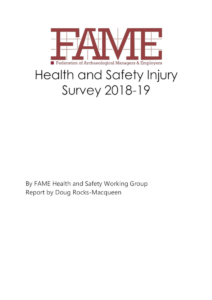
Part of FAME’s Health & Safety strategy is to assemble industry injury and accident data to allow organisations to benchmark their performance against the sector. We hope this data will provide a better picture of Health and Safety across our sector and may assist with the development of preventative measures and improved ways of working.
At first glance. archaeology appears to have a high RIDDOR injury rates. However, archaeology is a small field compared to other sectors which means one or two injuries can dramatically change the sectors ranking. Two archaeologists carrying a bulky piece of equipment together tripping and hurting themselves can easily change the rate for the whole sector significantly. We will need to average together several year’s data to be able to estimate the rates accurately and with precision. We appear to be similar in most aspects to the construction of buildings occupations which makes sense as they share work environments sometimes.
Of greater concern are non-RIDDOR reportabel injuries. For an injury to be RIDDOR reportable it has to be the result of a separate, identifiable, unintended incident, which causes physical injury. So, an injury or illness resulting in time off work is not reportable unless there is an identifiable event that caused the injury, for example, an object striking someone. Muscle injuries can be cumulative and repetitive stress injuries would also not be caught by RIDDOR reporting as they are not caused by a single event. In future surveys we will aim to collect better data on the non-RIDDOR reported injuries to better understand this.
FAME’s Health and Safety Working Group are concerned by these numbers. While we are comparable to those working in the construction of buildings we believe that is still too high for the work we do. FAME is currently sourcing training for manual handling and ergonomics for members to help lower these injury rates. We hope to have more information about this training soon.
We use cookies for login of members and to track views of pages. Continuing to use this site means you agree to our use of these cookies.