Championing Archaeological Businesses

Author: Doug Rocks-Macqueen

  • Options for Sustainable Archaeological Archives

    Options for Sustainable Archaeological Archives

    There is a new project jointly funded by Arts Council England and Historic England, to assess strategic options for the ongoing issue of storing archaeological archives. The options appraisal will review existing and future capacity for archaeological archives within England, considering a full range of archive solutions and evaluate their potential to meet the needs of archive creators, managers and users.

    The Mendoza Review of Museums (2017), which recognized a crisis in archaeological archive storage and access due to increased levels of archaeological work since the 1990s and reductions in funding, recommended the need to resolve the sustainability of archaeological archives. In response, Historic England and Arts Council England developed an Action Plan to address these long-standing challenges.

    This project forms part of that plan, aiming to understand how the museum and wider archaeological sector can be best supported to ensure a sustainable model for the long-term storage of archaeological archives. Specifically, this research and options appraisal will explore what capacity already exists, review its effectiveness and identify different models considering future needs and benefits – providing a comprehensive report to help inform next steps.

    The project team is led by Quinton Carroll (Cambridgeshire County Council, current chair of the Archaeological Archives Forum and of ALGAO: England), who will be working with Sally Croft (Cambridgeshire County Council), Samantha Paul (Independent consultant) and Manda Forster (DigVentures). The team will be circulating further information as the project progresses, including consultation surveys, and will contact a number of practitioners directly to discuss both existing and possible solutions.


  • Letter from Archaeology to the UK Prime Minister

    Letter from Archaeology to the UK Prime Minister

    FAME and many of the leading archaeology bodies have written to the Prime Minister about upcoming changes to the planning system. You can download and read the full letter here:

    2020-07-17 – CIfA CBA FAME ALGAO Rescue THA SAL letter to Boris Johnson

    Dear Prime Minister,

    ARCHAEOLOGY’S CONTRIBUTION TO CONSTRUCTION-LED RECOVERY

    We welcome the announcement that the government is committed to ensuring economic recovery through an ambitious programme of infrastructure spending and housebuilding. Development-led archaeology contributes to this goal by effective investigation, leading to greater understanding and conservation of heritage assets before and during development. There is a well-tested, staged system in the planning process designed to protect our historic environment, put it to work for public benefit, minimise costs and delays, and contribute to good place-making, local distinctiveness, and community identity. The UK is a world leader in archaeological research and development and our heritage management system is a model for others. Through their role in advising planning authorities and providing services to developers, archaeologists can enable well-balanced and informed planning decisions by assessing how heritage assets can be protected from needless harm, and how their investigation can add value to the development, to local people and the wider community. Where harm to the assets is necessary to deliver other public benefits, developers commission archaeological investigation and dissemination of findings, normally secured through planning conditions. The system works for the benefit of all. Over 30 years it has revolutionised our understanding of the past. It is not cited as a reason for major delay by developers [1], nor is it identified as a factor preventing build-out rates [2] [3].It removes from the public purse most of the cost (£258m in 2019 [4]) of safeguarding and unlocking a vital source for the history of our country. There are cases where existing policy has not been properly applied and in consequence the public has lost value that the proper application of the planning policy could have delivered. This has been manifested through unrecorded destruction of our history, whilst developers have suffered costs, delays and reputational damage. [5] Aspirations to ‘build back better’ must include safeguards that protect both the environment (in this case the historic environment) and a smooth development process.We are committed to ensuring that our work is proportionate, streamlined and as efficient as possible, but we need Government to leave us the tools we need to do our job in the nation’s recovery.Given the speed of reforms,please would you assure us that new approaches will maintain existing planning safeguards for the historic environment,protecting thousands of jobs in our industry and the local supply chain? More important, we ask whether you will ensure that our nation’s unique cultural heritage is conserved, investigated and interpreted so that everyone gains from the economic, social and environmental benefits it offers.

    Yours faithfully,

    1 Cornerstone Projects Ltd, Delays in Construction Projects(2017)

    2 Letwin, O. Independent Review of Build Out:Final Report(2018)

    3. Association of Local Government Archaeological Officers (ALGAO), Archaeology in Development Management(2019), p.16

    4 State of the Archaeological Market Survey Report,2019(2020)

    5 Chartered Institute for Archaeologists, Archaeology and Planning Case Studies,Vol. 1(2019) p.32

  • Impact of Covid-19 on Local Authority Archaeology Services

    Impact of Covid-19 on Local Authority Archaeology Services

    A rapid survey of ALGAO:UK members on how the Covid-19 pandemic has affected their work has been published. We are grateful to our colleagues in local authorities who have managed to maintain their planning advice, and supply of historic environment record data, during the Covid crisis. This has facilitated the work of our members, and helped our clients deliver sustainable development in spite of the challenging environment that the lockdown and ensuing return to work has created. The report commissioned by ALGAO presents a snapshot of archaeological planning advice and support for the UK as a whole, as well as by country and region. Report and more information can be found at the ALGAO website: https://www.algao.org.uk/news/impact-covid-19-local-authority-archaeology-services

    Despite the challenging working environment presented by the Covid Crisis, the overwhelming majority of ALGAO members have been able to continue to deliver services as they were able to do before the onset of the pandemic. This means that the availability of local government advice has not been a factor leading to a reduction in archaeological work.

    The majority (c.70%) of ALGAO members have continued to provide a full-service providing planning advice, policy advice, to comment on active developments and to provide Historic Environment Record services, with a further 28% recording a partial service but one focused upon planning and development management and advice.

  • Online conferences: Global Challenges, Sustainability and the Politics of Heritage and Pathways and Barriers to Climate Action through Heritage Research

    Please see the following call for two online conferences:

    AHRC Heritage is excited to host two timely half-day Conferences led by Hana Morel, titled Global Challenges, Sustainability and the Politics of Heritage and Pathways and Barriers to Climate Action through Heritage Research taking place online on Wednesday 22 and Thursday 23 July.

    The social and political changes needed for sustainability are complex and entangled alongside a new salience in research and its potential role towards decision-making. While certainly there is a push to improve our understanding of how to approach, understand and manage the Anthropocene, core challenges for the arts and humanities continue through discussion, debate and governance.  These half-day Conferences hope to contribute to the impressive energy and commitment of individuals, institutions and governments that continue despite current social arrangements, by exploring the role of heritage research within the sustainability and climate action movement, and what some of the opportunities and challenges are. Heritage studies itself offers a critical contribution to tackling global challenges, but is often merely an add on to research.

    Global Challenges, Sustainability and the Politics of Heritage, 22 July

    To register: https://heritage-research.org/events/global-challenges-sustainability-politics-heritage/

    The event will focus on:

    • What are the opportunities and challenges of the sustainability concept and how can heritage research contribute towards understanding it further?
    • How can heritage research help inform evidence-based policies related to sustainable development challenges, such as issues of social justice, instability, and legacies between nations and peoples?
    • Can heritage research help ensure successful implementation towards achieving sustainable development (e.g. through ensuring programmes understand and work within local contexts)?
    • How can heritage research support effective frameworks of government, or support the political will to transform research and innovation into sustainable long-term practices?

    Speakers include:

    Adala LeesonHead of Social and Economic Analysis and Evaluation, Historic England

    Alison HeritageProject Manager, ICCROM

    Beth PerryProfessorial Research Fellow, University of Sheffield

    Gameli Kodzo Tordzro, Research Associate, University of Glasgow

    Hana MorelResearch Associate, UCL 

    Harman SaggarHead Economists for Arts, Heritage and Tourism, DCMS

    Jack PhilipsEconomic Advisor, DCMS

    Kalliopi FousekiProgramme Director/Senior Lecturer for Sustainable Heritage, UCL

    Kelsea SellarsPolicy Researcher, Ubele

    Krystyna Swiderska, Principal Researcher, iied

    Michael StubbsLand Use and Planning Advisor, National Trust

    Sara TurnbullFounder/Director, WorkWild


    Pathways and Barriers to Climate Action through Heritage Research, 23 July

    To register: https://heritage-research.org/events/pathways-barriers-climate-action-heritage-research/

    The areas we are focusing specifically on are:

    • What can heritage research contribute towards characterising and qualifying climate-related risks?
    • How can heritage research help build resilience to climate variability and change without exacerbating existing inequalities?
    • What can heritage research offer climate services to help individuals and communities make climate-smart decisions?


    Speakers include:

    Albino Jopela, Head of Programmes, African World Heritage Fund

    Caitlin de Silvey, Professor of Cultural Geography, University of Exeter

    Carl Carrington, Head of Planning and Conservation, Blackpool Council

    Ewan Hislop, Head of Technical Research, Historic Environment Scotland

    Hannah Fluck, Head of Environmental Research, Historic England

    Kate Lonsdale, AHRC UK Climate Resilience Programme Champion, Leeds University

    Mariella de Soissons, Policy Advisor, Climate Change and Adaptation, Defra

    Navin Piplani, Principal Director, INTACH Heritage Academy, New Delhi

    Sandra Henry, Lead Research Archaeologist, CHERISH (Discovery Programme)

    Sanjay Johal, Community Flood Resilience Project Officer, National Flood Forum

    Victoria Bankes Price, Planning Advisor, Forestry Commission

    Yann Grandgirard, Project Manager, Edinburgh World Heritage

    Please register to attend either or both of these events, as you will receive the latest log in details via email.

    For these two half-day Conferences, we will be tweeting with the handle @AHRCHeritage using #SustainableHeritagePolicy and #HeritageClimateAction as our hashtags, so please do feel free to join us with your thoughts and discussions.

  • State of the Archaeological Market 2019

    As Chair of FAME I am very pleased to present the results of the 2018-19 State of the Archaeological Market Survey. Since 2008 the data from this annual survey have provided the foundation for analysis of the marketplace and the health of archaeological commercial practice, and has been used to extrapolate the contribution that commercial archaeology makes to the economy.

    Over the years it has demonstrated that archaeological organisations are flexible to cycles of boom and bust in the economy, and have developed a sustainable model for delivering archaeological services in support of the planning process, which in turn results in public benefit through the safeguarding, investigation and dissemination of knowledge for threatened parts of our heritage. The results from this survey corroborate previous ones in showing that professional archaeologists are now charging rates, and returning profits, on a par with other allied professions, and that we are re-investing in our businesses through staff training and development. It exposes shortfalls in certain skill sets, but it also helps in understanding who are the major funders of archaeology in the UK, and what market sectors most need our services.

    It is an essential source of information for a profession which frequently needs to make its case to government, and reinforce the value we bring for the good of society, to justify the developer-funding for archaeology required through the planning process.

    Tim Malim, Chair: Federation of Archaeological Managers and Employers

    You can download the report here: State of the Archaeological Market 2019 

    UPDATE: An earlier version had a Word to PDF conversion error. That has been fixed and the best version can be downloaded at that link.

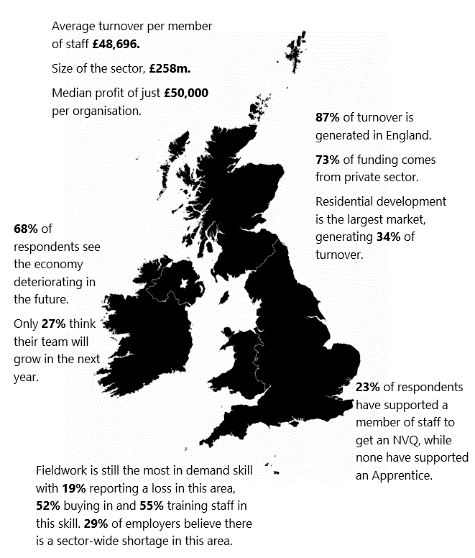
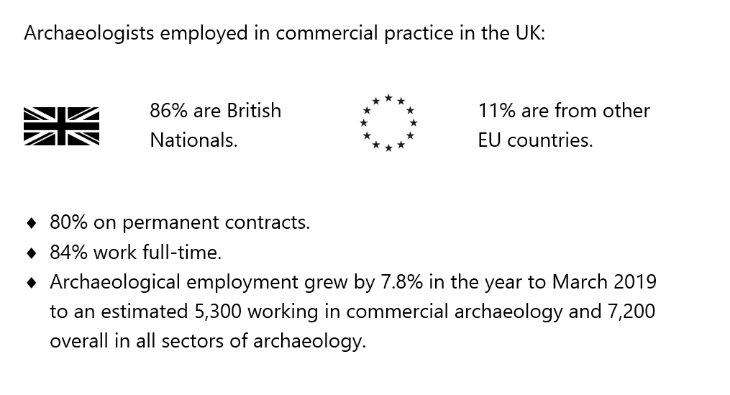
    Some key findings:

    This project was funded and supported by:

  • Heritage Alliance Members’ Covid and Advocacy Update

    FAME is a member of the Heritage Alliance. Here is there most recent update on various hertiage issues, though mainly on COVID-19:

    Some particular points to note from today include:

    • DCMS is pressing for clarity on when the heritage sector and visitor economy guidance will be released. Equally they are pressing for a clear view on whether the mooted date of 4th July for some re-openings will go ahead. There is as yet no decision but they will let us know when they know more;
    • There is a lot of internal work underway on the recovery agenda and DCMS is working closely with HMT on the various fiscal events that might come down the line. They are aware of the benefits of a 1m over 2m rule for the heritage sector and are grateful for the evidence fed through;
    • Visit Britain spoke at the meeting about a safety kitemark they have nearly finalised. This is intended to provide reassurance to the visitor and clear consumer messaging, backed up in a belief in a robust process. Globally they noted that it is best practice to have a standard especially as consumer tracking is showing a reduction in consumer confidence about a return to normality. It will be non-negotiable for participants in any scheme to follow certain guidelines, have carried out risk assessments, and agreed to a spot check process by assessors. There will be no cost on this for participants and it won’t be mandatory, but VB is trying to galvanise the industry behind it. They hope to have details finalised next week and DCMS will keep us posted.


    • The majority of the meeting was taken up with a hypothetical discussion on the impact of a second lock-down and what mitigation might be put in place. Your information was exceptionally useful and will be sent in its entirety to DCMS this week. Here’s a summary of the key themes in what you told us and we reported to Government:


      1. Financial: All organisations would struggle to survive without the JRS and Self-Employment Schemes resuming immediately alongside the small business grants schemes, business rates scheme and other measures. Even so, there are likely to be redundancies. We would need a continuation of support in the form of capital grants for repair works; without this year’s income a second lockdown would have a devastating effect on repair and maintenance, and on the survival of traditional skills and crafts. Funding from ALBs restricted to previous recipients would be increasingly challenging, as would the loss of funding for regular grants. Many small businesses and freelancers simply would not survive. A Stop and Start approach to lockdown is the most problematic as it allows no planning and prediction in visitors/staffing/cashflow. There are knock on costs around delays to construction projects. Fundraising ‘save’ campaigns may not get a second go.
      2. Staff and Volunteers: We would expect a further loss of volunteers and engagement which could lead to total un-engagement in some groups. Staff may leave if put on further furlough.
      3. Maintenance and repair: Loss of further income means there will be no cash to spend on maintenance and repair. Possibility of construction stopping again if not allowed under socially distanced guidelines.
      4. Events: Loss of further events and programming would be devastating; this is a key source of income for many (cathedrals, stately homes, museums etc).
      5. Summer vs winter: Most tourism businesses make up to 80% of income in the summer months. Some organisations may not be able to open again until the Spring depending on timings.
      6. Physical distancing is the biggest problem for many parts of the sector to keep functioning.
      7. Multiple refunds: these are challenging where public goodwill would be further stretched. Refunds of pre-booking systems now in play would be logistically challenging and expensive.


    How can DCMS/Govt support the sector?

    1. Information: clarity and as much notice as possible, appropriate and measured communications;
    2. Guidance: Some activities which were ‘not allowed’ during this lockdown would need to continue as exemptions i.e. maintenance, security, conservation. Construction must be able to continue.
    3. Funding: Immediate support and continuation of JRS, SEISS, CBILS, Bounce back loans, Grants. Heritage doesn’t have tangible products which can be sold later; the loss of income can never be made up. It only starts from zero the moment lockdown lifts (or less as there are costs for re-opening or restarting of projects (especially if these are stop-start);
    4. A positive messaging campaign from Govt, once opening is announced. Encourage the public to visit locally and holiday domestically, as long as the ‘quarantine’ is in place, we’ll need domestic visitors.
    5. Localised lockdowns – is it viable to look at avoiding a national close-down and whether some parts of heritage can continue such as outdoor areas. Nuance is crucial – does it have to be a blanket closure, are there specific exceptions? Real clarity in this space is needed – can we learn from the first experience and ensure doesn’t happen e.g. urban parks vs countryside locations?

    Other Covid news:

    DCMS Select Committee Submission

    • We have now submitted our response to the DCMS Select Committee’s inquiry into the impact of COVID-19. We had a very high level of engagement across our membership, and we have reflected your concerns.
    • Owing to the rules of the Select Committee, we are unable to publish our final response in full (until it is put up on parliament.uk), but the key points raised were around:
      • Mitigating the long-term impact of COVID-19 on the sector through further flexibility to the furlough scheme;
      • VAT equalisation on refurbishment to boost the sector;
      • Positive messaging campaign to reboot visitor confidence and expectation;
      • Supporting heritage skills into the future.
    • Once published online, we will share the final version with you.

    Guidance: safe use of places of worship

    • The government has published guidance on the safe use of places of worship during COVID-19. This includes for private prayer and for funerals. Some churches and places of worship are now open for these purposes and the Cof E reported today that there has been a muted but positive response.
    • The full guidance can be found here.


    Guidance: updates to the furlough scheme

    • The government has published some useful guidance to explain the changes to the furlough scheme from 1 July. We ran our first legal roundtable this week with our corporate partners Bates Wells on this and other HR topics. Many thanks to those who attended. News soon on a second event…
    • The full guidance can be found here.

    DCMS Business Survey

    • The results of a survey carried out by DCMS between 23 April and 22 May have been released.
    • DCMS will be publishing selected headline findings in the coming weeks, but have made the full data set available here.
    • Initial headline data, which finds that over 65% of respondents’ businesses are at immediate risk, can be found here.


    Treasury Select Committee Report

    • The Treasury Select Committee has published its report on gaps in support for employees and the self-employed here. The key recommendations in the report are for the government to:
      • Find a way to extend eligibility criteria to all new starters.
      • Remove the £50,000 cap for SEISS and allowing those with profits just over this cap access to some financial support, up to the total monthly support cap of £2,500.
      • Support limited company directors who are missing out on support because they pay themselves in dividends.
      • Give PAYE freelance workers access to financial support that equates to 80 per cent of their average monthly income earned in the first 11 months of the 2019–20 tax year.
      • Extend support to those newly self-employed who are unable to benefit from the SEISS.


    VisitBritain COVID-19 Consumer Tracker Report

    • The latest report from the VisitBritain sentiment tracker is now available. Fieldwork was completed 1-5 June, and finds that the national mood is slightly down from 6.7 to 6.6.
    • Full results can be found here.


    VisitEngland “Get Ready to Open” Business Resource Centre

    • VisitEngland have developed a new website to bring together all the guidance and resources available to businesses on reopening.
    • It includes government guidance, relevant webinars, and other bits worth your time.
    • The website can be found here.


    New HSE Guidance

    • HSE have developed a range of guidance for businesses on how to protect both staff and customers, which can be found here.

    We also continue to update our Heritage Alliance Guidance Hub and Funding Hub, which provide the latest information and funding sources to support you and your organisation through COVID-19.


    Non-Covid Matters:

    Royal Albert Memorial Museum & Art Gallery rating decision

    • It was confirmed on Wednesday that the Court of Appeal has refused permission for the Valuation Office to further appeal the original decision over the rateable valuation of the Exeter’s Grade II listed Royal Albert Memorial Museum & Art Gallery (RAMM). This is a really important ruling for many of our members who have been watching this case and may have broad applicability.
    • The full story can be read here: https://rammuseum.org.uk/rates/


    DfID to merge with FCO

    • The Prime Minister announced on Wednesday that the Department for International Development would be merged with the Foreign and Commonwealth Office, to create a new “super department” that would be responsible for both foreign policy and aid.
    • Further details here.

    Black Lives Matter Protests

    Finally we are very keen to understand the perspectives of our members on debates raised by the Black Lives Matter campaigns and protests, and the related matters of memorials. Historic England’s most recent statement is here: https://www.english-heritage.org.uk/about-us/search-news/historic-memorials-statues-and-black-lives-matter

    • Has your organisation produced any statements on the matter, received enquiries or taken a stance that you would be happy to share with us?
    • Has your work been affected in any way by moves against physical monuments, memorials or buildings?
    • Do you have any positive stories of engagement, reporting or thinking around these matters that you can share?
    • What, if anything, would you like to see from the Heritage Alliance in this space?
  • QUEST COVID info and Support for FAME members

    FAME’s business support has provided the following resources:

    FAQ version v12

    The change is about clarification on previously announced elements and examples around calculating a claim for flexible furlough.

    We have also included a link to the HMRC website. Changes again in yellow.

    Coronavirus Job Retention Scheme – FAQ v12

    Health & Safety Guides

    If you do so please don’t forget to refer them to the Chamber Advice Line on 01455 852037 and the document library

    There is also a signage pack you can send them, which could be useful

    Getting Your Business Covid Secure – Manufacturing Warehousing Engineering (v1)

    Getting Your Business Covid Secure – Office

    Signage Pack_Covid-19 _QBS 2020

    HR Documents

    Don’t forget that all documents relating to the Job Retention Scheme and furloughing staff can be found in section 12 of the HR document library. Accessible for FAME members in the member area.

  • U.S. Heritage Compliance (CRM) Sector Contracts in 2019

    FAME member, Heritage Business International, has released some research on the Archaeology Sector in the United State:

     The United States’ heritage compliance sector contracted in 2019 by about 10 million dollars. This contraction marks the ninth year in a row of negative growth for the sector since its historic high in 2011. The compliance sector of the heritage industry includes work performed by heritage and environmental firms to achieve compliance with environmental and cultural resource requirements. It is sometimes referred to as the Cultural Resource Management or CRM industry.

    These figures come from the just released 2020 edition of the annual industry size report published by Heritage Business International. The report contains a preface on COVID-19, key sector-size statistics, a breakdown of size by U.S. geographic region, historical graphs, and a data table of nominal and real size in dollars and percent annual change going back to 1971. This year’s report includes a new breakdown of size by client industry and key notes throughout the report to assist readers in understanding these data.

    Read the full media release here: HBI News Release 8 June 2020


  • Heritage Alliance COVID update

    Heritage Alliance COVID update

    FAME is a member of the Heritage Alliance and would like to pass along this communication from them to our members:


    Dear members,

    We hope you are keeping safe and well. A big thank you to those of you who have fed in specific evidence this week for us on both the DCMS’s questions on social distancing (and the varying benefits of 1m vs 1.5 or 2m) and the jeopardy certain sub sectors are facing at present. At the meeting of the Heritage Working group this afternoon with the Minister Nigel Huddleston, I raised various examples of where a 1m rule would really improve the viability of some operations, improving capacity and ability to earn income as well as allow certain activities that would otherwise be very challenging such as running steam trains and travelling to archaeological sites.

    Following on from the cases I raised last week around the mobile heritage sector, today I focussed on archaeology (professional, local authority and community), religious buildings and conservation. Your evidence was described as sobering and really helps us make the case for interventions. We have attached to this email a summary of some of the key areas we have advocating on where positive results have emerged. This demonstrates the impact we can have as a broad and collective voice for the independent sector.

    It was helpful to hear from Emma Squire, Culture Director, this week on some areas they will be continuing to look for evidence from us on. These include:

      • They would welcome evidence and input on where insurance is proving challenging and blocking organisations from getting help;
      • Commercial rent;
      • Ideas for regulatory easements;
      • Non pharmaceutical interventions e.g. The examples I mentioned on economic impacts relating to social distancing;

    She noted that she is aware there is a lot in the press on the arts and museums, and she wants to reassure us that any package DCMS will be pressing for from the Treasury will be truly aimed at culture and heritage in the round, including skilled craftspeople. They want to continue to understand from us where interventions are needed where certain cliff edges might hit for various parts of our membership. With this in mind, please do keep sending your concerns to us, your information shapes our work and informs the priorities we raise: policy@theheritagealliance.org.uk

    Other areas to keep an eye on include:

    • Guidance on places of worship will be published imminently (we understand tonight or tomorrow) ahead of churches being able to open for private prayer on 15th June. More on the MHCLG taskforce here.
    • We don’t yet have a date for the heritage specific guidance we have been working on with Historic England (leading) and DCMS, alongside visitor attraction and tourism guidance but again we expect to hear more on the publication date soon;
    • Following some sustained lobbying by Historic Houses at the weekly meetings, DCMS confirmed today that BEIS will be taking responsibility for issues around weddings.

    We also heard some positive news from the National Trust and Historic Houses of where successful re-openings are beginning and how they are picking up new visitors and seeing much public joy at being able to visit. Families are using their sites for emotional and socially safe reunions. We see the power of heritage for wellbeing and community in cases such as these. Those reopening are sharing their stories with other sites who are further behind in the journey. At the Alliance we are also very keen to hear your lessons learned and positive stories from around the sector where return to projects, workplaces and opening of sites has been managed.

    We have also this afternoon sent a letter to DCMS Secretary of State Oliver Dowden (attached), setting out some of our current key asks and some concerns as we move out of the initial emergency stage of Government intervention and look to build recovery. We will also be writing to the Treasury shortly.

    We will be running a series of bespoke and free legal roundtables for our members with our legal Partner Bates Wells. The first of these (hopefully next Wednesday PM) will be focussed on the changes to the furlough scheme and the new flexibilities. Delphine will be in touch shortly with details of how to book on. We know how useful this will be for some of our member organisations (and for your own members where relevant) so please do join in.

    Latest government updates

    • Last night, the Prime Minister announced that Zoos, drive-in cinemas, and non-essential retail shops can reopen to the public from Monday. Zoos will have to keep their indoor enclosures, such as reptile houses, closed.
    • A new “support bubble” can now be made between a single-parent household and another household. This allows those living alone (or with only a child under 18) to join with another household. Further information here.
    • An FAQ page has been added to guidance to help local authorities and partners deliver activities supported through the Reopening High Streets Safely Fund.

    Sending Forms to Companies House

    • Companies House has introduced a temporary service that allows businesses to upload documents that previously had to be sent in. This includes documents such as:
      • Applying for a rectification by the registrar of companies
      • Correcting a director’s date of birth which was incorrectly stated on incorporation
      • Applying for rectification of a change of registered address
      • Objecting to a request to rectify the register
      • Applying to remove material about a director
      • Applying to change a company’s disputed registered office address
    • Further details can be found here.

    Latest BVA-BDRC report

    • BVA-BDRC have released their latest report on consumer sentiment.
    • The full report can be found here.

    Guidance on Boat Use

    • The Government has produced more detailed guidance for a wide range of boat use – both coastal and inland This covers everything from marinas, boat hire, tour boats and canoe hire. The main points are:
      • Canoes and paddle craft hire firms can operate but must clean equipment and practice social distancing;
      • Self-drive boats or bareboat charter businesses can open but only for people using the boats for day-trips – so overnight use of canal boats and cruising yachts is still prohibited;
      • Tourist and trip boat operators must remain closed;
      • Marinas may open to allow people to visit and move their boats;
      • Private boat owners cannot stay overnight on their boat unless the boat is their primary residence.
    • The full guidance can be found here.

    BEIS Round Tables on economic recovery

    • As reported a few days ago, Alok Sharma has announced that he’s setting up five round tables to consider the measures needed to support the UK’s economic recovery from Covid-19. The round tables are: The future of industry; Green Recovery; Backing new businesses; Increasing opportunity; and, How to win and retain more high value internationally mobile investment for the UK.
    • If you would like to provide input on these areas, you can do so by email to Economic.Recovery@beis.gov.uk The deadline for input is Wednesday 17 June.

    Impact of Coronavirus on Employment

    • The ONS has released new statistics on the impact of Coronavirus on the UK workforce which shows that the tourism and hospitality businesses have been among the most affected sectors of the economy. The main points are:
      • The total number of employers that made at least one CJRS claim to 31 May 2020 is 1.07 million
      • 8.7 million employments have been supported through the scheme under claims made until 31 May, with these claims totalling £17.5 billion
      • 6,300 large employers (those with 250 or more employees) have furloughed around 2.5 million employments.
      • Accommodation and food services employers have furloughed 1.4 million employments and claimed £2.6 billion in support under the CJRS.
    • The full report can be found here.

    We also continue to update our Guidance Hub and Funding Hub, which provide the latest information and funding sources to support you and your organisation through COVID-19.

  • Heritage Alliance Members’ Covid Update

    Heritage Alliance Members’ Covid Update

    FAME is a member of the Heritage Alliance. Here is there most recent update on COVID-19 and the Heritage sector:

    This morning we had another constructive Heritage Working group meeting with Heritage Minister Nigel Huddleston focussed on the development of guidance for the heritage sector which needs to be in place as we emerge from lockdown. If there are things you feel you need to see in guidance please keep feeding these thoughts and questions through to Hannah as there will be a very tight turnaround on this. DCMS will also be working to align guidance produced that crosses between our sector and others within their remit such as museums, arts, tourism and with colleagues in other departments (such as MHCLG on places of worship) to ensure as much consistency as possible.

    We have started to hear experiences from those organisations who have begun to open their outdoor spaces in line with health and safety guidelines and the Government’s clarifications about ticketed venues. If you have been opening or are planning to do so shortly we would love to hear from you – both the positives and any emerging challenges.

    Please see other  weekly updates below:

    Government updates

    Further easing of lockdown rules

    • The government has tonight announced a further “limited” and “cautious” easing of the lockdown in England from Monday, noting that the five tests it set out have now been met.
    • From Monday (1 June):
      • Nursery, Year 1 and Year 6 pupils will be able to return to school;
      • Groups of up to six people will be able to meet outside, including in private gardens;
      • Outdoor markets and car showrooms will be able to reopen.
    • From 15 June:
      • Secondary schools will offer some face-to-face contact for Years 10 and 12
      • All other non-essential retail will be able to open.
    • The Prime Minister cautioned that people should continue to avoid seeing people from too many households in quick succession, to try and limit the spread of the virus.
    • Those who have been asked to shield should also continue to do so.

    Update to guidance on accessing green spaces

    • Last weekend, following extensive sector lobbying, a new form of words was added to the government guidance on accessing green spaces, which now states clearly that in England, members of the public can:
    • “visit gardens and land maintained for public use as an alternative open space to spend time outdoors, although buildings and amenities such as cafes will remain closed and access may be limited to members or those with tickets to ensure social distancing. You should check ahead and follow social distancing guidelines”
    • The full guidance can be found here.


    Lords Debate on supporting museums, galleries, and historic buildings through COVID-19

    • As noted in the last update, last Thursday, the House of Lords held a Short Debate on supporting museums, galleries, and historic buildings through the COVID-19 crisis. We produced a brief setting out the key issues facing our members and sent it to the Lords due to speak. We have attached it to this email.
    • 47 Lords spoke in total, and covered many of the points we raised. You can see the full record on Hansard here.

    Revised Discretionary Fund Guidance

    • The guidance to Local Authorities on the £617m Discretionary Fund has been amended so that businesses that are eligible for SEISS are still eligible for support through this fund.
    • The full guidance can be found here.

    Public transport funding

    • The government has announced additional £254 million of funding for buses and an additional £29 million for trams and light rail to help maintain and increase the frequency of services, to help ensure social distancing guidelines can be observed.
    • Full details here.


    Coronavirus Statutory Sick Pay Rebate Scheme now live

    • Employers with fewer than 250 employees can now claim for up to two weeks of coronavirus-related Statutory Sick Pay (SSP). In order to file a claim businesses must be registered with PAYE Online and must have already paid employees’ SSP. Forms are now open for employers to check whether they are eligible and file a claim online.


    Two new advisory boards to co-ordinate London’s COVID-19 recovery

    • The London Transition Board, co-chaired by Communities Secretary Robert Jenrick and London Mayor Sadiq Khan, will co-ordinate London’s response as it emerges from lockdown and safely reopens the economy. The London Recovery Board, co-chaired by the Mayor of London and Cllr. Peter John, Chair of London Councils, will advise on the city’s wider long-term economic and social recovery.


    ALVA recovery tracker

    • The Association of Leading Visitor Attractions (ALVA) [Alliance member] has shared the results of Wave 1 and Wave 2 of its ‘Attractions Recovery Tracker’, which offer key insights into how people are feeling about returning to attractions
    • These excellent reports are readily accessible here via the AIM [Alliance member] website.


    BEIS Webinars on Making Your Workplace Safe

    • BEIS is running a series of webinars on safe working. These seminars are based around the eight workplace-related guidance notes published so far.
    • You can sign up to these webinars here.

    BVA-BDRC report on consumer sentiment

    • BVA-BDRC have published a report tracking consumer sentiment on the impact of COVID-19 on travel and mobility, leisure, and hospitality.
    • The report finds that the intention to plan, book and take a UK holiday have both increased significantly this week, and the intention to visit attractions is at its highest since the tracking began.
    • The full report can be found here.

    National Lottery Community Fund now open


    • A £200m fund has been launched aimed primarily at small to medium organisations in England. The fund is part of the Government’s £750m financial support package for charities and social enterprises announced by Government on April 8. The National Lottery Community Fund will distribute the Government funding alongside National Lottery funding, to support organisations to continue to deliver services to people and communities affected by COVID-19. Full details on how to apply can be found here. Funding will prioritise:


    • Organisations supporting people and communities who experience disproportionate challenge and difficulty as a result of the COVID-19 crisis;
    • Organisations providing services and support for vulnerable people, for which there will be increased demand as a result of the COVID-19 crisis;
    • Organisations which connect communities and support communities to work together to respond to COVID-19.


    Rt Hon Sir Patrick McLoughlin CH and Nick de Bois Appointed Chairs of VisitBritain and the Visit England Advisory Board

    • In other news, the Government has announced that Rt Hon Sir Patrick McLoughlin and Nick de Bois have respectively been appointed as the Chair of VisitBritain and the Visit England Advisory Board.


    We continue to update our Guidance Hub with the latest information related to COVID-19. We have also pulled together a Funding Hub which collates funding sources that may help you and your organisation.