Championing Archaeological Businesses

Author: Doug Rocks-Macqueen

  • New Report – Archaeology in Development Management

    ALAGO has just released a new report, Archaeology in Development Management. You can download the report here – https://www.algao.org.uk/archaeology-development-management

    “New research into the benefits of archaeology work undertaken under the control of Local Authorities across Britain has been published by the Association of Local Government Archaeological Officers (ALGAO) today (6th September 2019)

    Archaeological work was fully incorporated into the planning system across the UK in the early 1990s to manage the impacts that development may have upon the historic environment. The report presents the results of research conducted by Landward Research Ltd for ALGAO:UK, on the archaeology sector in developmental management and its contributions in England, Scotland and Wales.

    The report looks at; the positive impact the existing system makes on the sector and beyond, how successful the existing system is and whether it is delivering the process it was created for.

    It’s the first detailed piece of research into the topic by ALGAO and it highlights the savings produced by the current system as well it’s the contribution to the economy:

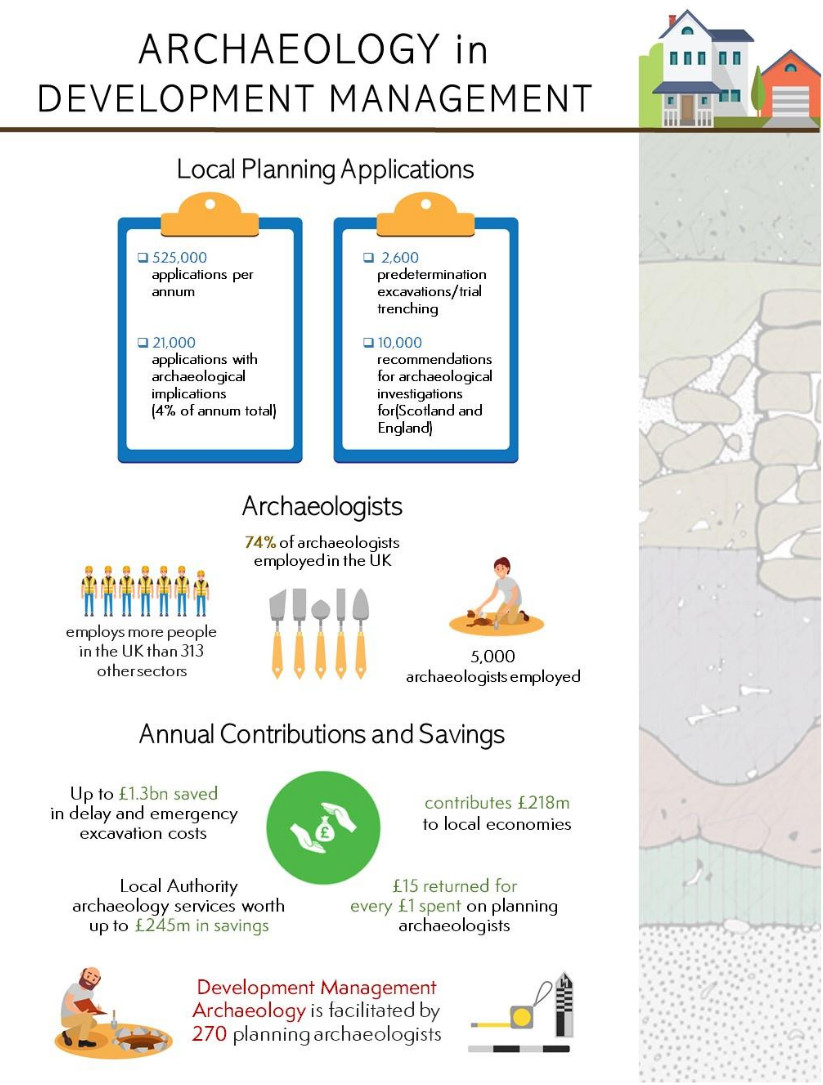
    • Commercial Archaeology makes a £218m direct contribution to the economy
    • For every £1 spent on Local Authority Planning Archaeology £15 is returned.
    • 5000 (74%) archaeologists are employed because of the developmental management system
    • Work of members provides up to an estimated £1.3bn in savings to construction industry through reduced delay costs in 2017-18 alone
    • Current provision of Local Authority based archaeological services worth up to £245m in savings to public purse in 2017-18

    John Lawson, Chair of ALGAO said:

    ‘’Today’s report by Landward Research has highlighted the essential role currently played by our members in providing expert in-house advise to our Authorities. We enable the conservation of our historic environment at a local level whilst supporting successful development, employment and tourism. Local Authorities are at the heart of promoting the wider public benefits of our rich historic environment, for the benefit of all

    “This report demonstrates the value of incorporating archaeological services into the planning system, and the positive impact this approach can have in terms of the economy and understanding of our historic environment.”

    Kenneth Aitchison, Chief Executive Officer of FAME, the Federation of Archaeological Managers and Employers, said: “This report is really important. It shows the value of ALGAO expertise and emphasises the critical need for this in the planning system. It is ALGAO members’ expertise in local authority planning archaeology that enables FAME members to deliver high-quality archaeological investigations that provide real benefits to society. Without ALGAO, FAME wouldn’t be able to do the work we do”.

    Doug Rocks-Macqueen, from Landward Research said: “We have always guessed that development control archaeology contributes greatly to communities but quantifying the results has been surprising. The impact it has on England, Scotland and Wales is far greater than what we had imagined”.

  • FAME Members Can Now Pay Dues by Direct Debit

    To reduce the administrative load on some of our members FAME has now set up direct debits through the provider GoCardless. With direct debit one only needs to signup once to make annual payments instead of having to pay invoices every year. For current members to sign up for direct debit please use the following links:

    Sole Traders can sign up here – https://pay.gocardless.com/AL0002H4GDH3W7

    Those with 2-5 employees here – https://pay.gocardless.com/AL0002FZDN6CJT 

    Those with 6-50 employees – https://pay.gocardless.com/AL0002H2ESPJMS

    And those with 51+ employees – https://pay.gocardless.com/AL0002FZDXP6RG

    Not a member? Learn more about joining FAME here – https://famearchaeology.co.uk/what-we-do/join/

  • Historic England: Call for input on CPD courses

    Historic England: Call for input on CPD courses

    Please see the follow call for input from Historic England on training:

    Historic England is inviting views from sector colleagues on the sort of training that you would like us to deliver. Our corporate plan demonstrates our commitment to developing the skills and knowledge of the heritage sector. Our Training Strategy provides further detail on the need for training, which is underpinned by unprecedented social and economic pressures that are impacting on the availability of key resources. As part of its work to address these issues, Historic England provides CPD training through three programme: Essentials, HELM and Heritage Practice.

    The Heritage Practice programme aims to disseminate our staff’s expertise in practical, technical and specialist tools needed to protect heritage. This content goes beyond that which Historic England funds as part of the dissemination of government advice and policy, which means we have to recover any costs incurred by charging for delegate places. Because we have recently brought the delivery of the Heritage Practice programme in-house, we would like to find out more about the sector’s need for training.

    Historic England is therefore conducting a programme of market research, through an online survey available at this link. https://www.surveymonkey.co.uk/r/ZMZH8MJ The survey is mainly multiple choice and should take less than 15 minutes to complete. It is open until September 30th 2019.

    At the end of the survey, you will be asked about your preferences for further information. If you choose to be contacted in future, we can add you our mailing list about our training offer and keep you updated about the findings of this research.

    Finally, please do feel free to forward this to any interested colleagues and contacts. And apologies for any cross-posting – we have circulated the survey quite widely.

    Thanks very much
    Historic England Training Delivery Team


  • Innovation in professional practice: short survey

    CIfA is requesting help with gathering some information:

    Please could you spare a few minutes (c. 5 minutes) to complete this short survey to support a project entitled Building capacity through innovation co-organised by CIfA and ALGAO and funded by Historic England. The project addresses the results from the Historic England/CIfA 21st century challenges for archaeology workshop discussions in 2017 which identified some possible barriers to incorporating innovation and new techniques/methods to commercial archaeological practice etc on a consistent and regular basis. This survey forms the initial groundwork for this project and aims to find out how professionals working in the historic environment sector currently learn about new innovative approaches, how they’re incorporated into working practices and what the primary barriers are to their consistent use at the present time.

  • Manual handling

    Manual handling

    Archaeology can involve a significant amount of manual handling. The Health and Safety Executive has a great guide for keeping employees safe while undertaking manual handling that we recommend to all archaeological employers. You can purchase a hard copy for download a free copy here – http://www.hse.gov.uk/pubns/indg143.htm


  • Reminder: Advice on working in warm weather

    Reminder: Advice on working in warm weather

    We have posted this before but with the heat wave FAME would like to remind people that the Diggers’ Forum (DF) have put together some guidance on working in warm weather. You can download the document here – DF Warm Weather Working in Archaeology

    The document in html form:

    “Now we are well in to what shall optimistically be referred to as spring/summer, we are starting to think about those nice warm days and heady temperatures of above 17oC.

    I jest, but warmer weather is on the way and the Diggers’ Forum committee thought it was about time we put together a few handy hints and tips to help get through the summer (both weeks of it).

    Your employer should have a risk assessment for working in warm weather, make sure you are talking to your project management about any adaptations that could be made to keep you and your colleagues safe, for example, is your PPE suitable for the task you are undertaking?

    As outdoor workers Diggers are exposed to high temperatures for long periods, and are at a higher than average risk of overexposure to UV radiation. Along with those ridiculous tan lines, this can lead to heat stroke, heat exhaustion, and of course, skin damage which in turn can lead to an increased risk of skin cancer.

    So, on that jolly note why not try to:

    Reschedule work for cooler times of the day, such as earlier in the morning or later in the afternoon when levels of UVR are less intense. Try to stay out of the sun during the hottest part of the day. We know that this is in fact an entirely ridiculous notion, alternatively, try to rotate between indoor/shaded and outdoor tasks to minimise exposure.

    Wear sunscreen. Ideally this should be of a high factor and re-applied regularly. In an ideal world your employer would provide a generic brand of sunscreen, and some do. However, it is important to acknowledge that individuals could have a variety of skin allergies and other requirements which could make this impractical. All things considered it’s perhaps just best to bring your own.

    Cover up. Yes, no one likes to wear long sleeves, and yes it is hot, but there is nothing sexy about cancer, and you do know that long-term sun exposure speeds up the skin’s ageing process, right? Dry and wrinkled skin? Nice.

    Drink plenty of cool water and keep hydrated. Your company should make sure that you are provided with sufficient drinking water.

    If you’re baking, the ground is too and prolonged mattocking is likely to lead to injury and contribute to Repetitive Strain Injury. And remember heat stroke is more likely when heavy physical work is being done, so pace your work rate.

    Heat exhaustion is caused by the loss of salt and water from the body by excessive sweating. Left untreated it can lead to heat stroke so it is important to take care of yourself. Signs to look out for are:

    • Headache, dizziness and confusion
    • Loss of appetite and nausea
    • Sweating, with pale, clammy skin
    • Cramps in the arms, legs or abdomen

    Heat stroke is the most severe form of heat-related conditions, and is caused by the failure of the body to regulate temperature, resulting in the body becoming dangerously overheated. Symptoms include:

    • Headache, dizziness and discomfort
    • Restlessness and confusion
    • Hot, flushed and dry skin
    • Body temperature of above 40oC

    Take extra rest breaks, whenever you feel you need one (but don’t take the piss), and make sure there is shade in rest areas, remove PPE when resting to help encourage heat loss, and clothing (including PPE) should ideally not be tight or restricting, it should allow body heat to escape.

    Report any symptoms of heat stroke/exhaustion/burning to your supervisor or on-site first aider.

    Drink plenty of cool water and keep hydrated. Your company should make sure that you are provided with sufficient drinking water.

    Useful links:
    http://www.hse.gov.uk/temperature/thermal/managers.htm
    http://www.hse.gov.uk/temperature/outdoor.htm
    www.sunsafeworkplaces.co.uk

  • CRM Financial Performance Statistics Released for 2018

    FAME member, Heritage Business International L3C (HBI), has released the results of its annual Cultural Resources Management (CRM) Financial Performance Survey for 2018.
    The report that details internal business statistics for CRM firms. The report is used by firms to benchmark their performance against competitors in the industry, as a check on financial
    health, and as a basis for strategic and operational planning.
    You can read more about the release here: HBI News Release June 2019.

    Are you a FAME member and want us to promote your work? Please get in touch with your news items.
  • Call for Papers: HS2 and the TAG Conference 2019 – treatment of the dead in current archaeological practice

    Please see below this call for papers relating to professional archaeology and the treatment of bodies:

    We would like to draw your attention to the forthcoming TAG conference, 16-18 December in London.

    HS2 Ltd are organising a session ‘The treatment of the dead in current archaeological practice’ – we are particularly interested in discussing the political, ethical and social impacts of human remains research, including for health, belief, and for local, regional and national identity.

    We are looking for a broad range of papers about the sites on HS2 and further afield, emphasising the role of knowledge about the past in the present, as well as the most current debate about aspects of archaeological evidence itself.

    https://www.ucl.ac.uk/archaeology/news-events/conferences/tag-2019/conference-sessions-1-30

    The theme of the Conference is ‘Power, Knowledge and the Past’ and Plenary session, ‘What is the past good for in the world of 2020?’

    Abstracts (250 words) for a 15 minute paper should be directed to Andrea Bradley Andrea.Bradley2@hs2.org.uk

    before 16 August 2019.


    Are you a FAME member and want us to promote your work? Please get in touch with your news items.
  • The Future of ScARF

    The Future of ScARF

    The the Society of Antiquaries of Scotland is looking to plan for the future development of the Scottish Archaeological Research Framework (ScARF). To accomplish this they have launched a survey. The survey covers the national framework and emerging regional frameworks: Future Thinking on Carved Stones in Scotland; RARFA; SESARF, HighARF, SIRFA, and PKARF.  If you have ever used or had any involvement with ScARF, please complete this short survey which will close on Wednesday 31st July.

    Launched in 2012, the framework was designed to provide an ever growing record of the state of knowledge about Scotland’s past, in order to inform research priorities. It provides a platform for researchers to both contribute and access research findings. Latterly the development of regional frameworks has sought to add regional detail to the national picture. This survey seeks views from all users about how you use ScARF; your experience of contributing to the evolving regional frameworks; and priorities for future development. The survey is mostly multiple choice and should take no more than ten minutes to complete.

    The survey link: https://www.surveymonkey.co.uk/r/XBZ2XD7

  • Apprenticeships update (England) from CIfA

    On update from CIfA on development of archaeology apprenticeships in England:


    Apprenticeship standards development

    In England, work has progressed on the development of Trailblazer Apprenticeships through three Historic England convened working groups. The groups have overseen the development of apprenticeship standards covering archaeology, conservation and historic environment advice. The archaeology working group is chaired by CIfA and includes representatives from several ROs including MOLA, Oxford Archaeology, Cotswold Archaeology, Albion Archaeology, Wessex Archaeology and Salford Archaeology. It has focussed on two areas, the development of an entry level (Level 3) Archaeological Technician apprenticeship and a higher level (Level 7) Archaeological Specialist degree apprenticeship. Both standards have now been approved by the Institute for Apprenticeships and Technical Education (IfATE) and can be seen at www.instituteforapprenticeships.org/apprenticeship-standards/archaeological-technician/ and www.instituteforapprenticeships.org/apprenticeship-standards/archaeological-specialist/

    Assessment plans

    As well as the apprenticeship standard setting out the knowledge, skills and behaviours required for the role, each apprenticeship has an assessment plan which details how they will be assessed. Assessment plans are also required to be approved by the IfATE and an apprenticeship can only be approved for delivery once both sets of documents are in place.

    The assessment plan for the Level 3 Archaeological Technician has now been approved and formally published. The plan for the Level 7 Archaeological Specialist was approved earlier this year subject to amendments which have now been submitted and we hope that this apprenticeship will also be formally published shortly.

    Training providers

    The last piece in the jigsaw is to identify training providers and assessment providers to deliver the off-job training element of the apprenticeship and the final assessment. CIfA is in the process of registering to become an assessment provider and we have been working alongside colleagues at Historic England to identify training providers. We have had some very useful discussions with several further education colleges who currently include archaeology in their provision, most recently with Strode College which has indicated that it would be able to develop the necessary content for apprenticeships to start in January 2020. Strode College is also working with Historic England on the training provision for a Level 4 assistant historic environment advisor apprenticeship https://www.instituteforapprenticeships.org/apprenticeship-standards/historic-environment-advice-assistant/ which has also now been formally approved and published.

    Next steps

    The process of developing apprenticeships has been long and, at times, tortuous as the working groups have navigated a number of changes of policy and direction, with overall responsibility shifting from the Department for Business, Industry and Skills to the Department for Education and finally to the Institute for Apprenticeships. However, with the prospect of the first apprentices starting in just over 6 months time, we’re now looking forward to working with ROs to ensure that those that wish to take on apprentices are supported through the process. Apprenticeships can be used for upskilling existing staff as well as training new recruits and more information about how to recruit and support apprentices will be circulated shortly but if you have any questions in the meantime, please contact Kate at kate.geary@archaeologists.net.