Championing Archaeological Businesses

Author: Doug Rocks-Macqueen

  • Self-isolating after returning to the UK and employment

    Self-isolating after returning to the UK and employment

    Yesterday, the Government released new guidance on quarantining and Employment Rights for England:

    https://www.gov.uk/guidance/self-isolating-after-returning-to-the-uk-your-employment-rights

    The other home nations have their own guidance:

    Wales: https://gov.wales/how-self-isolate-when-you-travel-wales-coronavirus-covid-19

    Scotland: https://www.gov.scot/publications/coronavirus-covid-19-public-health-checks-at-borders/pages/self-isolation/ (updated August 24th)

    Northern Ireland: https://www.nidirect.gov.uk/articles/coronavirus-covid-19-travel-advice

    Broadly they all require 14 days of quarantine if coming back from a country not on the approved list. Work can undertaken from home during that time. Given how quickly that list and rules can change, Scotland reviews its regulations everyone 21 days, FAME members are advised to check with their staff leaving the country for work or  holiday and plan for them to do home work for two weeks after they return, even if the country they are visiting is currently on the approved list as that is subject to change at short notice.

  • Options for Sustainable Archaeological Archives – update

    Options for Sustainable Archaeological Archives – update

    The Arts Council England and Historic England funded project, Options for Sustainable Archaeological Archives, is currently seeking input from archaeologists from across to sector, to help build an up-to-date picture of archaeological archives. There are two ways you can help the project – if you have not already done so…

    An organisational survey aims to fill in the period between the FAME survey of 2012 and today’s picture, with an update questionnaire about archives held in archaeological organisations. The project team are keen to understand what capacity will be needed in the future and would be grateful if you could help by completing this survey: https://www.surveymonkey.co.uk/r/3RKRQ29

    In addition, consultation workshops are inviting practitioners to join a cross-sector discussion. The Rethinking archaeological archives workshops will bring together colleagues from various walks of heritage and archaeology life, to discuss a series of questions and challenges about how we use archives. Due to popularity, the team is increasing capacity for the workshops, so we hope you can get a place!

    The workshops will take place on Thursday 27 August and Thursday 03 September, from 10 – 12. You can find more information and the link for registration below.

    You can find more information about the project from the webpages (link above) and if you have any questions, please feel free to email the project manager, Manda Forster manda@digventures.com

  • Development-Led Archaeology in Scotland and Covid-19

    A new publication supported by FAME / ALGAO members in Scotland has been published, Development-led Archaeology in Scotland and Covid-19. This publication has brought together contributors from across Scotland, involved in both the commercial and curatorial sides of development-led archaeology to show the sector’s resilience in the face of the effects of the Covid-19 pandemic.

  • FREE WEBINAR – Tips for Attaining a Sustainable Cultural Heritage Career

    FAME member Heritage Business International will be participating in free webinar – Tips for Attaining a Sustainable Cultural Heritage Career.

    Please find attached a pamphlet for more information: HBM Webinar Invite 8.4.2020

  • HS2 and Project Bank Accounts

    HS2 and Project Bank Accounts

    HS2 Ltd has announced it will approve the use of Project Bank Accounts (PBAs) across key contracts on Phase One. PBAs are when payments are made out of one pot and do not have to cascade through multiple tiers of contractors. On time payments is an issue that FAME has been helping to tackle for several years now. Please see this presentation delivered at the FAME forum several years ago and  NSCC Fair Payment leaflet for more discussion on the issue:

    Fair Payment FAME TJPN 2015 06 26

    Fair payment Credit Where Credit Isn’t Due (Booklet – for print)

  • Options for Sustainable Archaeological Archives

    Options for Sustainable Archaeological Archives

    There is a new project jointly funded by Arts Council England and Historic England, to assess strategic options for the ongoing issue of storing archaeological archives. The options appraisal will review existing and future capacity for archaeological archives within England, considering a full range of archive solutions and evaluate their potential to meet the needs of archive creators, managers and users.

    The Mendoza Review of Museums (2017), which recognized a crisis in archaeological archive storage and access due to increased levels of archaeological work since the 1990s and reductions in funding, recommended the need to resolve the sustainability of archaeological archives. In response, Historic England and Arts Council England developed an Action Plan to address these long-standing challenges.

    This project forms part of that plan, aiming to understand how the museum and wider archaeological sector can be best supported to ensure a sustainable model for the long-term storage of archaeological archives. Specifically, this research and options appraisal will explore what capacity already exists, review its effectiveness and identify different models considering future needs and benefits – providing a comprehensive report to help inform next steps.

    The project team is led by Quinton Carroll (Cambridgeshire County Council, current chair of the Archaeological Archives Forum and of ALGAO: England), who will be working with Sally Croft (Cambridgeshire County Council), Samantha Paul (Independent consultant) and Manda Forster (DigVentures). The team will be circulating further information as the project progresses, including consultation surveys, and will contact a number of practitioners directly to discuss both existing and possible solutions.


  • Letter from Archaeology to the UK Prime Minister

    Letter from Archaeology to the UK Prime Minister

    FAME and many of the leading archaeology bodies have written to the Prime Minister about upcoming changes to the planning system. You can download and read the full letter here:

    2020-07-17 – CIfA CBA FAME ALGAO Rescue THA SAL letter to Boris Johnson

    Dear Prime Minister,

    ARCHAEOLOGY’S CONTRIBUTION TO CONSTRUCTION-LED RECOVERY

    We welcome the announcement that the government is committed to ensuring economic recovery through an ambitious programme of infrastructure spending and housebuilding. Development-led archaeology contributes to this goal by effective investigation, leading to greater understanding and conservation of heritage assets before and during development. There is a well-tested, staged system in the planning process designed to protect our historic environment, put it to work for public benefit, minimise costs and delays, and contribute to good place-making, local distinctiveness, and community identity. The UK is a world leader in archaeological research and development and our heritage management system is a model for others. Through their role in advising planning authorities and providing services to developers, archaeologists can enable well-balanced and informed planning decisions by assessing how heritage assets can be protected from needless harm, and how their investigation can add value to the development, to local people and the wider community. Where harm to the assets is necessary to deliver other public benefits, developers commission archaeological investigation and dissemination of findings, normally secured through planning conditions. The system works for the benefit of all. Over 30 years it has revolutionised our understanding of the past. It is not cited as a reason for major delay by developers [1], nor is it identified as a factor preventing build-out rates [2] [3].It removes from the public purse most of the cost (£258m in 2019 [4]) of safeguarding and unlocking a vital source for the history of our country. There are cases where existing policy has not been properly applied and in consequence the public has lost value that the proper application of the planning policy could have delivered. This has been manifested through unrecorded destruction of our history, whilst developers have suffered costs, delays and reputational damage. [5] Aspirations to ‘build back better’ must include safeguards that protect both the environment (in this case the historic environment) and a smooth development process.We are committed to ensuring that our work is proportionate, streamlined and as efficient as possible, but we need Government to leave us the tools we need to do our job in the nation’s recovery.Given the speed of reforms,please would you assure us that new approaches will maintain existing planning safeguards for the historic environment,protecting thousands of jobs in our industry and the local supply chain? More important, we ask whether you will ensure that our nation’s unique cultural heritage is conserved, investigated and interpreted so that everyone gains from the economic, social and environmental benefits it offers.

    Yours faithfully,

    1 Cornerstone Projects Ltd, Delays in Construction Projects(2017)

    2 Letwin, O. Independent Review of Build Out:Final Report(2018)

    3. Association of Local Government Archaeological Officers (ALGAO), Archaeology in Development Management(2019), p.16

    4 State of the Archaeological Market Survey Report,2019(2020)

    5 Chartered Institute for Archaeologists, Archaeology and Planning Case Studies,Vol. 1(2019) p.32

  • Impact of Covid-19 on Local Authority Archaeology Services

    Impact of Covid-19 on Local Authority Archaeology Services

    A rapid survey of ALGAO:UK members on how the Covid-19 pandemic has affected their work has been published. We are grateful to our colleagues in local authorities who have managed to maintain their planning advice, and supply of historic environment record data, during the Covid crisis. This has facilitated the work of our members, and helped our clients deliver sustainable development in spite of the challenging environment that the lockdown and ensuing return to work has created. The report commissioned by ALGAO presents a snapshot of archaeological planning advice and support for the UK as a whole, as well as by country and region. Report and more information can be found at the ALGAO website: https://www.algao.org.uk/news/impact-covid-19-local-authority-archaeology-services

    Despite the challenging working environment presented by the Covid Crisis, the overwhelming majority of ALGAO members have been able to continue to deliver services as they were able to do before the onset of the pandemic. This means that the availability of local government advice has not been a factor leading to a reduction in archaeological work.

    The majority (c.70%) of ALGAO members have continued to provide a full-service providing planning advice, policy advice, to comment on active developments and to provide Historic Environment Record services, with a further 28% recording a partial service but one focused upon planning and development management and advice.

  • Online conferences: Global Challenges, Sustainability and the Politics of Heritage and Pathways and Barriers to Climate Action through Heritage Research

    Please see the following call for two online conferences:

    AHRC Heritage is excited to host two timely half-day Conferences led by Hana Morel, titled Global Challenges, Sustainability and the Politics of Heritage and Pathways and Barriers to Climate Action through Heritage Research taking place online on Wednesday 22 and Thursday 23 July.

    The social and political changes needed for sustainability are complex and entangled alongside a new salience in research and its potential role towards decision-making. While certainly there is a push to improve our understanding of how to approach, understand and manage the Anthropocene, core challenges for the arts and humanities continue through discussion, debate and governance.  These half-day Conferences hope to contribute to the impressive energy and commitment of individuals, institutions and governments that continue despite current social arrangements, by exploring the role of heritage research within the sustainability and climate action movement, and what some of the opportunities and challenges are. Heritage studies itself offers a critical contribution to tackling global challenges, but is often merely an add on to research.

    Global Challenges, Sustainability and the Politics of Heritage, 22 July

    To register: https://heritage-research.org/events/global-challenges-sustainability-politics-heritage/

    The event will focus on:

    • What are the opportunities and challenges of the sustainability concept and how can heritage research contribute towards understanding it further?
    • How can heritage research help inform evidence-based policies related to sustainable development challenges, such as issues of social justice, instability, and legacies between nations and peoples?
    • Can heritage research help ensure successful implementation towards achieving sustainable development (e.g. through ensuring programmes understand and work within local contexts)?
    • How can heritage research support effective frameworks of government, or support the political will to transform research and innovation into sustainable long-term practices?

    Speakers include:

    Adala Leeson, Head of Social and Economic Analysis and Evaluation, Historic England

    Alison Heritage, Project Manager, ICCROM

    Beth Perry, Professorial Research Fellow, University of Sheffield

    Gameli Kodzo Tordzro, Research Associate, University of Glasgow

    Hana Morel, Research Associate, UCL 

    Harman Saggar, Head Economists for Arts, Heritage and Tourism, DCMS

    Jack Philips, Economic Advisor, DCMS

    Kalliopi Fouseki, Programme Director/Senior Lecturer for Sustainable Heritage, UCL

    Kelsea Sellars, Policy Researcher, Ubele

    Krystyna Swiderska, Principal Researcher, iied

    Michael Stubbs, Land Use and Planning Advisor, National Trust

    Sara Turnbull, Founder/Director, WorkWild


    Pathways and Barriers to Climate Action through Heritage Research, 23 July

    To register: https://heritage-research.org/events/pathways-barriers-climate-action-heritage-research/

    The areas we are focusing specifically on are:

    • What can heritage research contribute towards characterising and qualifying climate-related risks?
    • How can heritage research help build resilience to climate variability and change without exacerbating existing inequalities?
    • What can heritage research offer climate services to help individuals and communities make climate-smart decisions?


    Speakers include:

    Albino Jopela, Head of Programmes, African World Heritage Fund

    Caitlin de Silvey, Professor of Cultural Geography, University of Exeter

    Carl Carrington, Head of Planning and Conservation, Blackpool Council

    Ewan Hislop, Head of Technical Research, Historic Environment Scotland

    Hannah Fluck, Head of Environmental Research, Historic England

    Kate Lonsdale, AHRC UK Climate Resilience Programme Champion, Leeds University

    Mariella de Soissons, Policy Advisor, Climate Change and Adaptation, Defra

    Navin Piplani, Principal Director, INTACH Heritage Academy, New Delhi

    Sandra Henry, Lead Research Archaeologist, CHERISH (Discovery Programme)

    Sanjay Johal, Community Flood Resilience Project Officer, National Flood Forum

    Victoria Bankes Price, Planning Advisor, Forestry Commission

    Yann Grandgirard, Project Manager, Edinburgh World Heritage

    Please register to attend either or both of these events, as you will receive the latest log in details via email.

    For these two half-day Conferences, we will be tweeting with the handle @AHRCHeritage using #SustainableHeritagePolicy and #HeritageClimateAction as our hashtags, so please do feel free to join us with your thoughts and discussions.

  • State of the Archaeological Market 2019

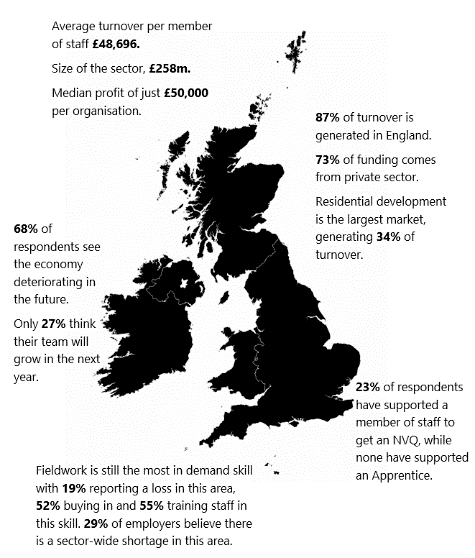
    As Chair of FAME I am very pleased to present the results of the 2018-19 State of the Archaeological Market Survey. Since 2008 the data from this annual survey have provided the foundation for analysis of the marketplace and the health of archaeological commercial practice, and has been used to extrapolate the contribution that commercial archaeology makes to the economy.

    Over the years it has demonstrated that archaeological organisations are flexible to cycles of boom and bust in the economy, and have developed a sustainable model for delivering archaeological services in support of the planning process, which in turn results in public benefit through the safeguarding, investigation and dissemination of knowledge for threatened parts of our heritage. The results from this survey corroborate previous ones in showing that professional archaeologists are now charging rates, and returning profits, on a par with other allied professions, and that we are re-investing in our businesses through staff training and development. It exposes shortfalls in certain skill sets, but it also helps in understanding who are the major funders of archaeology in the UK, and what market sectors most need our services.

    It is an essential source of information for a profession which frequently needs to make its case to government, and reinforce the value we bring for the good of society, to justify the developer-funding for archaeology required through the planning process.

    Tim Malim, Chair: Federation of Archaeological Managers and Employers

    You can download the report here: State of the Archaeological Market 2019 

    UPDATE: An earlier version had a Word to PDF conversion error. That has been fixed and the best version can be downloaded at that link.

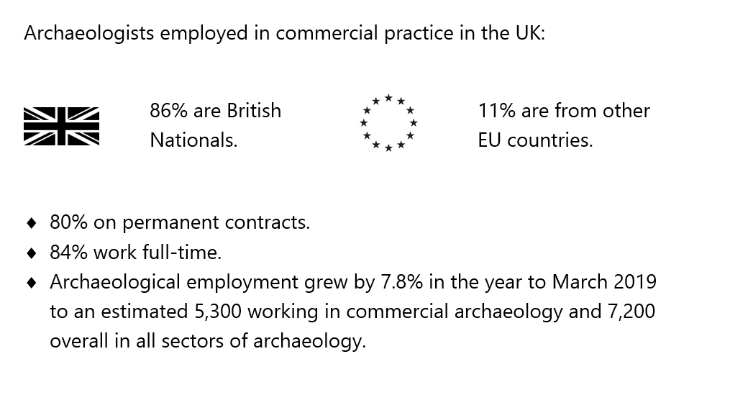
    Some key findings:

    This project was funded and supported by: